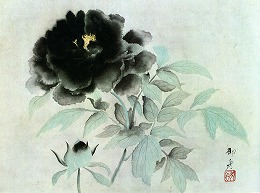
His original surname was Makita and his given name Eiichi. In 1908, at four (by the Japanese count), he entered Fuko Matsumoto’s Angado studio near his home; Seiju Omoda entered on the same day. In 1910 his work was selected for the Tatsumi Gakai, and in 1911 he received a first-class honourable mention there; he came to know Shiko Imamura and joined the Koji-kai. From 1913 he received the support of Sankei Hara and lived for a time in Kyoto. In 1914 he took his mother’s family name of Hayami and the art name Gyoshu. He moved to Meguro in Tokyo, became an associate of the Japan Art Institute, and formed the Sekiyo-kai with Shiko and others. In 1917 he moved to Kyoto again and showed “Six Subjects Outside the Capital” at the fourth Inten, winning high praise from Taikan Yokoyama and others and becoming a member of the Japan Art Institute. In 1925 he completed “Dance of Flames” (Important Cultural Property). In 1929 he showed “Camellia Petals Scattering by a Famous Tree” (Important Cultural Property) at the sixteenth Inten. From the minute description of his early years he gave form to a world of fantasy, and went on to bring realism and decoration together, leaving a great mark on modern Japanese painting. His constantly innovative work was widely influential, but he died of typhoid in 1935 at the age of forty.