about us
about us
access
books
related websites
sitemap
collection
Buy online
Categories
Japanese paintings
Oil paintings
Calligraphy
Woodblock prints
Sculpture
Pottery
Others
Artists
Contemporary Artists
Masters
Request a work
Order our art catalogue
how to order
contact
exhibitions
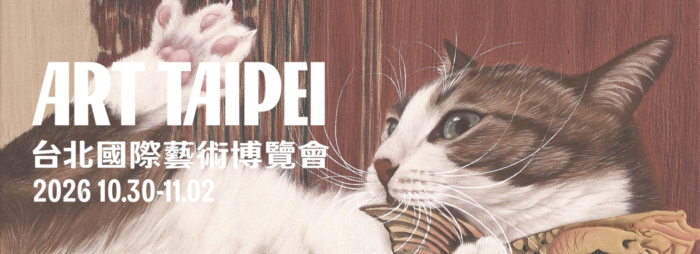
ART TAIPEI 2026
October 30 (Fri) – November 2 (Mon), 2026
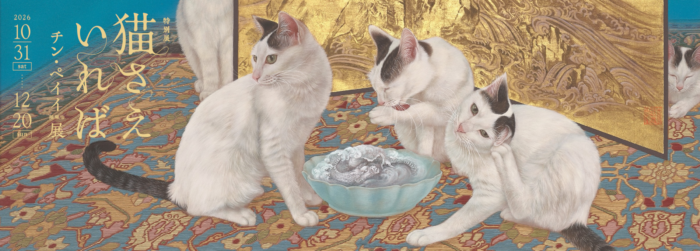
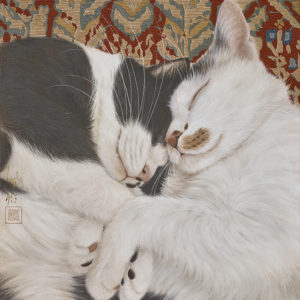
Special Exhibition — All I Need Is a Cat: Chen Pei-Yi
October 31 (Sat) – December 20 (Sun), 2026
All exhibitions
read & research
Features
Bijinga: a column by Chiaki Tanaka
Meet the Master Collectors
Artist Encyclopedia
access
Gallery Syukado
Sone Bldg. 7F
Address
Sone Bldg. 7F, 6-4-8 Ginza,
Chuo-ku, Tokyo 104-0061, Japan
Contact
Tel.
+81-3-3569-3620
How to find us
Related websites
Art & Antique Purchasing
GALLERY SCENA
Ukiyo-e Gallery Syukado
sitemap
日本語
contact
order catalog
SHUKADO gallery
about us
collection
exhibitions
read & research
access
sitemap
日本語
contact
order catalog
about us
access
books
related websites
sitemap
Related websites
Art & Antique Purchasing
GALLERY SCENA
Ukiyo-e Gallery Syukado
Buy online
Categories
Japanese paintings
Oil paintings
Calligraphy
Woodblock prints
Sculpture
Pottery
Others
Artists
Contemporary Artists
Masters
Request a work
Order our art catalogue
how to order
contact
Related websites
Art & Antique Purchasing
GALLERY SCENA
Ukiyo-e Gallery Syukado
ART TAIPEI 2026
October 30 (Fri) – November 2 (Mon), 2026
Special Exhibition — All I Need Is a Cat: Chen Pei-Yi
October 31 (Sat) – December 20 (Sun), 2026
All exhibitions
Related websites
Art & Antique Purchasing
GALLERY SCENA
Ukiyo-e Gallery Syukado
Features
Bijinga: a column by Chiaki Tanaka
Meet the Master Collectors
Artist Encyclopedia
Related websites
Art & Antique Purchasing
GALLERY SCENA
Ukiyo-e Gallery Syukado
Gallery Syukado
Sone Bldg. 7F
Address
Sone Bldg. 7F, 6-4-8 Ginza,
Chuo-ku, Tokyo 104-0061, Japan
Contact
Tel.
+81-3-3569-3620
How to find us
Related websites
Art & Antique Purchasing
GALLERY SCENA
Ukiyo-e Gallery Syukado
›
Features
›
A list of our feature articles. We build them around an artist, around a season, around whatever theme suggests itself. We hope they may help you come upon a piece you take to, or an artist we would press upon you.
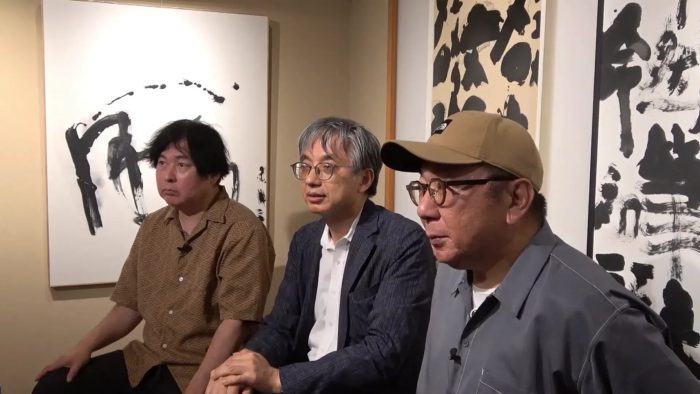
Gallery talk: Nangaku Koun × Hisashi Yamamoto × Chiaki Tanaka — “Where ART SHODO stands now: can calligraphy evolve?”
Modern Art / Ginza — an exhibition of modern bijinga
Choice works by the masters of modern bijinga — Takehisa Yumeji, Kaburaki Kiyokata, Ito Shinsui, Kainosho Tadaoto and others — shown in Modern Art / Ginza: an exhibition of modern bijinga (4–8 February 2025).
The women they paint, graceful and finely drawn, are a crystallisation of a beauty particular to Japan, where the traditional and the modern cross.
The works in the exhibition are for sale. We hope you will feel what bijinga can do, and take some of that beauty home with you.
Under the spell of the deepening autumn
In literature and in music there is no end of fine work made out of autumn.
Autumn stirs an artist and gives generously; painters are no exception.
It is not only the colour, which belongs to painting directly. The air, the temperature, the sounds, the smells, even the taste of the season find their way into the picture.
Along with the people and the animals in them, we hope you will taste in these paintings the feeling for autumn the painter put there.
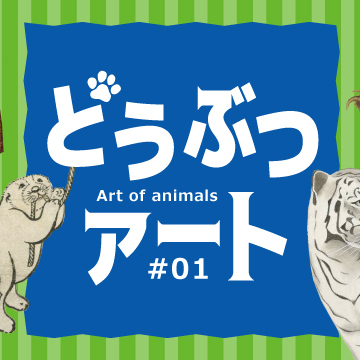
Animals in art #01
From tigers and elephants, which we see now only at the zoo, to the horse, the ox and the dog, which lived close to daily life, all manner of animals are to be found in Japanese art. Seeing them set down — sometimes in full dignity, sometimes endearing — is one of the great pleasures. And the animals chosen as subjects were not chosen at random: very often there is a meaning, or a whole tradition, behind them.
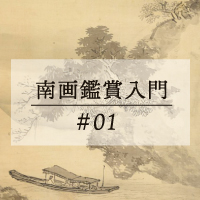
An introduction to looking at nanga #01
Whether you already care for nanga or are still asking what nanga is, we hope you will let yourself down into this free and far-reaching world, which grew out of a spring of deep learning and cultivation. Nanga will be on show at Gallery SHUKADO in Ginza from Wednesday 15 to Tuesday 21 July 2020. Please enjoy both together.
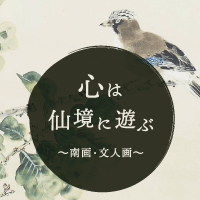
The mind at play among the immortals — nanga and bunjinga
The world of nanga and bunjinga, loved and practised by the cultivated and the learned. In the press of modern life, surely now is the moment to look again at their inwardness and their unhurried mind. We have picked out work, old and new, in which the spirit of nanga is still breathing.
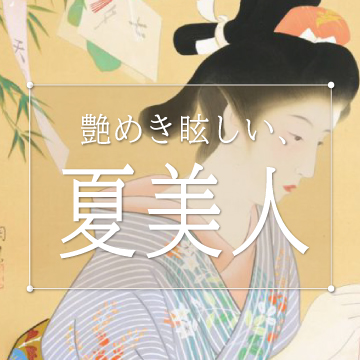
Summer beauties, radiant and alluring
A moment of coolness under a blazing sky. Summer beauties charming enough to make you forget the heat.
Bijinga is more than figure painting: alongside the lovely woman it takes in the kimono and its ornament, flowers and birds and grasses, landscape, the look of the season and the manners of the age, and has grown deeper for it. From that much-loved and brilliant subject we have chosen work on the theme of summer.
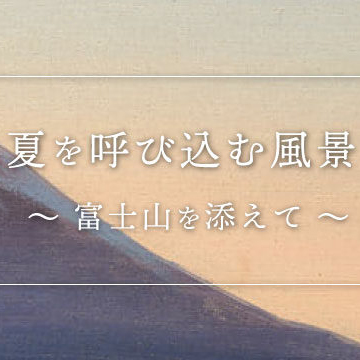
Landscapes that call in the summer — with Mount Fuji
Early summer arrives, fresh and clear. Bathed in bright sunlight, the country takes on colour and life by the day. The new green that seems to draw a cool wind after it, and the great sweep of a panorama, are both here inside these paintings. We present a group of fine works to call the summer into the heart.
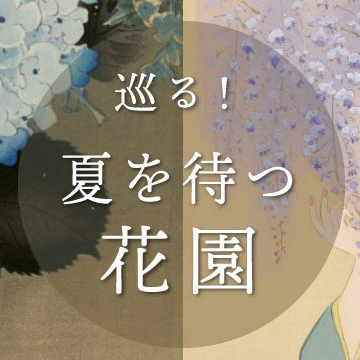
A turn around the flower garden, waiting for summer
Early summer is coming, fresh and clear. In gardens and here and there about the town, flowers of every colour will be out and crowding one another. Getting out into that new green is not easy just now — so why not look at paintings instead, in the spirit of a turn around an early summer garden?
Not only Amabie: Japanese art to hang at home and drive misfortune off
Amabie became a figure of the moment in the wake of the coronavirus. Japan has loved all manner of auspicious signs for centuries, celebrating good fortune and courting luck. Look at them and the heart lifts; hang them in the room and — who knows — misfortune may take itself off. We show here, above all, the motifs said to ward off ill luck and disease.
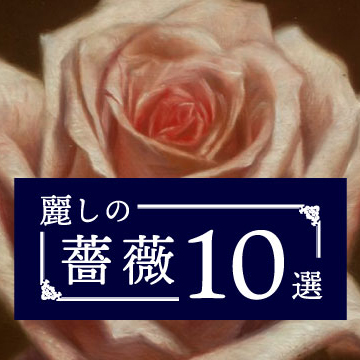
Ten roses
The rose, loved the world over as the queen of flowers. The flower that gave rise to any number of myths and stories has been enjoyed in Japan since the days of the Man’yoshu; it came into fashion among gardeners in the Edo period, and from the Meiji period was taken up quickly by the upper classes. The rose: lustrous, honoured, unlike any other flower. See what love, and what challenge, painters have put into it.
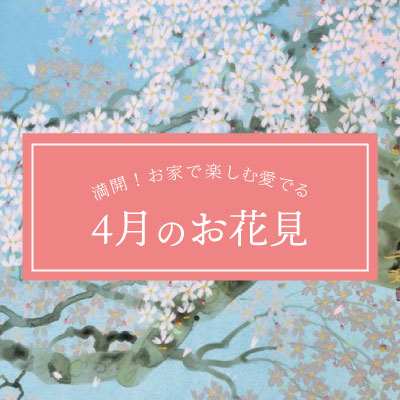
In full bloom: hanami at home in April
The cherry-blossom season, and the front of blossom is moving north while nobody can get out to enjoy it properly. Let us go blossom-viewing in art instead. Hang one painting, one scroll in the room, and there is your garden in full flower. Cherry blossom with a beautiful woman, too, has all the colour and grace of the spring. Find the piece that is yours, and the hanami seat that is yours alone.
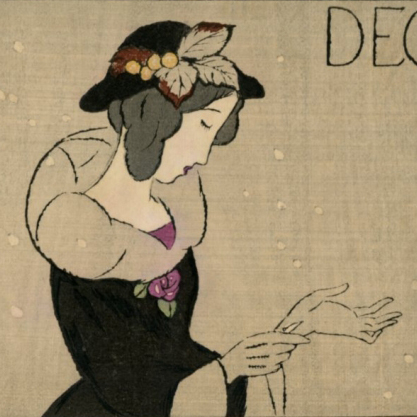
Takehisa Yumeji: “A life lived in dreams”
Dark eyes, large-pupilled and swimming; an expression at once listless and somehow forlorn.
The lyrical women called Yumeji beauties still hold the men, the women and the impressionable young girls of this world captive. Do you know, by the way, the posthumous Buddhist name given to Yumeji, who left this world at forty-nine?
Kosaiga in Japan, jiaocai in Taiwan
Jiaocai, which came up in Chen Peii’s profile, is — to put it simply — a way of working that uses the same technique as nihonga. In Japan this kosaiga is usually gathered under the broad heading of nihonga, so the word is seldom heard. In Taiwan the same two characters are read jiaocai.
The difficult, delightful world of Ito Seiu, part 4 (final)
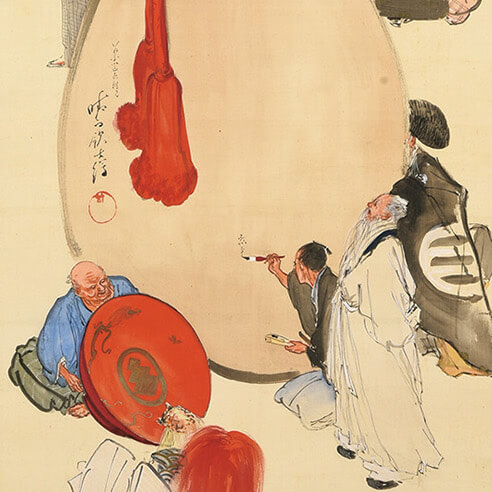
Here is part four, the last, of our long-running series on the difficult, delightful world of Ito Seiu. The readings have been getting harder to argue for, but let us take on the puzzles that remain. So then: lower right, a figure half hidden behind the gourd. What stands out is the family crest resist-dyed on the back — two bars within a circle.
The difficult, delightful world of Ito Seiu, part 3
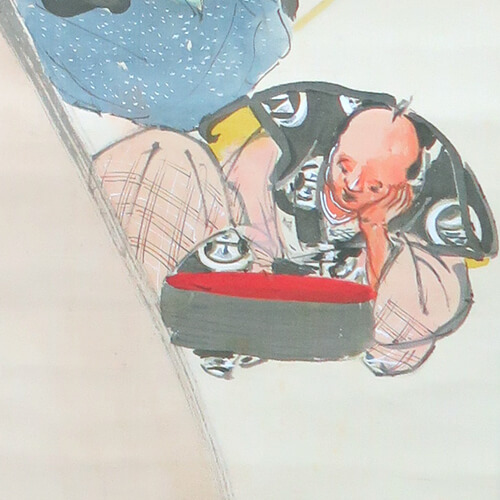
Next, then. Centre right: a figure resting his chin on his hand beside what looks like a tub. There is something deadpan about him. Note the pattern of the kimono — takara-zukushi, the assembled treasures, set in roundels. Roundel takara-zukushi is a pattern often used for kyogen costume.
The difficult, delightful world of Ito Seiu, part 2
The horse out of the gourd, planted squarely in the middle, is plain enough — but what of the other figures in kimono drawn around the gourd? What are these subjects? Are they, like the horse out of the gourd, all proverbs? Here is how our puzzled editorial staff went about solving (or trying to solve) the riddle of the sheet.
The difficult, delightful world of Ito Seiu, part 1
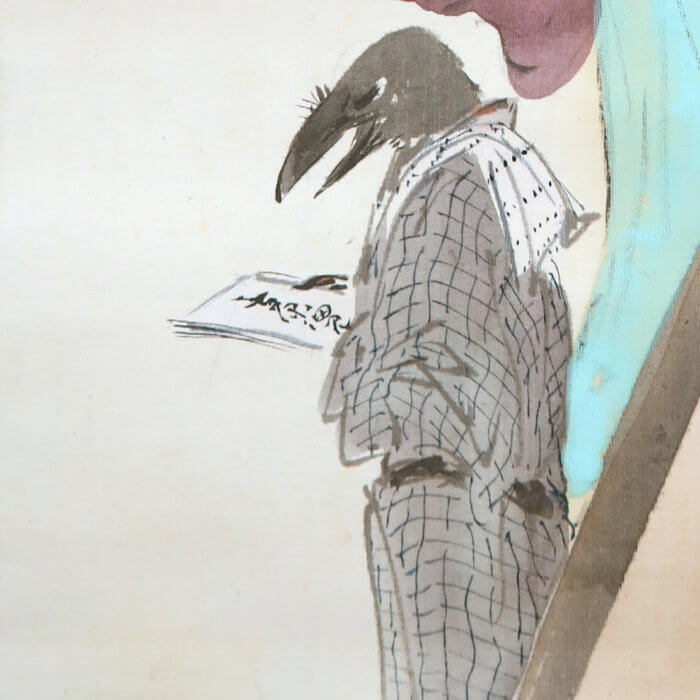
Ito Seiu’s work looks unremarkable at first — scenes of Edo manners, things dashed off lightly — and yet motifs are worked into it, sometimes faintly, sometimes beyond mistaking. This time we take up Seiu’s early life, and the moments where you say: so that was it.
Yokai and ghosts
In 2014 the thermometer was passing thirty degrees around the country from May, and a fierce summer was in prospect.
So here is an early midsummer greeting from SHUKADO: a chill down the spine, by way of ukiyo-e of monsters and ghosts.
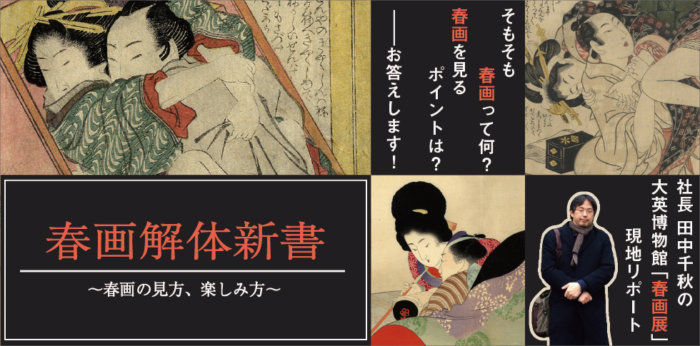
Shunga: a new anatomy
The shunga exhibition at the British Museum has closed, and closed in triumph.
It was popular enough that on some days entry had to be limited; it drew a great deal of public attention, and the major British newspapers gave it a good deal of space.
Sadly, no touring version could be arranged for Japan, where the work was made.
So SHUKADO is mounting a shunga exhibition of its own, at short notice. (The exhibition has since closed.)
The greatest entertainment ever staged: Kanadehon Chushingura
At the Kabukiza, ten minutes’ walk from SHUKADO, Kanadehon Chushingura ran for two months from November as the opening programme of the rebuilt theatre.
And Chushingura does not belong to Japan alone: 47 Ronin, starring Keanu Reeves, opened on 6 December.
Kanadehon Chushingura, a bold reworking of the Ako affair of the Genroku era, has lost none of its hold. Why does Chushingura take us as it does? We look for the secret in ukiyo-e.