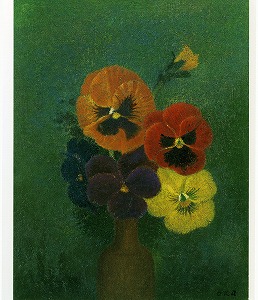
Born in Tokyo, the eldest son of Kitaro Oka, the well-known drama critic. After graduating from the Tokyo School of Fine Arts in 1924 he went to France. The following year “Landscape” was selected for the Salon d’Automne. In the exhibition hall he was troubled to find the matière of his own work inferior to that of Western painting, and set about a basic study of pigments and canvas, beginning a pointillist technique of his own. This was not the divisionism of the Neo-Impressionists: he restrained the touch and added an effect of blurring, balancing colour values while seeking on the canvas a unified brown tonality and a firm construction. He also found that the patient process of setting down small touches one by one suited the unhurried rhythm of his temperament. At a time when most Japanese painters who went to Europe inclined towards Fauvist feeling through emphatic brushwork, he stands apart in aiming at a construction based on the intellectual analysis Japanese painters find difficult. He returned to Japan in 1939, became a member of the Shunyokai the following year, and left many quiet, poetic and fanciful landscapes, often of snow. He received the Japan Art Academy Prize in 1964, and in 1968 became a member of the Academy and received the Order of Culture.