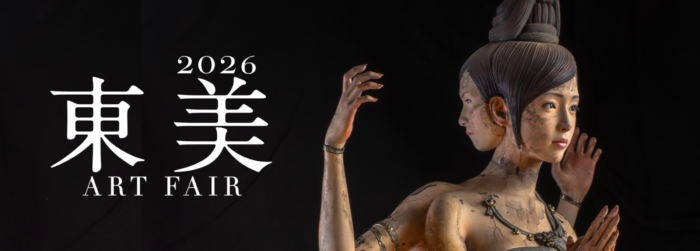
Tokyo Art Club Fair 2026
October 16 (Fri) – October 18 (Sun), 2026


(In the photograph, from the left: Yamamoto, Tanaka, Nangaku)
Here is a record of the gallery talk “Where ART SHODO stands now: can calligraphy evolve?”, held at Gallery SHUKADO in Ginza on 23 August.
The exhibition and the gallery talk
Close on fifty people came (our apologies to those we could not fit in).
Nangaku Koun and Hisashi Yamamoto each carry something of their own — the tradition on one side, the contemporary on the other. Around the discussion we had in the room and the questions from the floor, we have set down what lay behind the exhibition Zero Shodo, what the works are, and where calligraphy might go from here.

The title Zero Shodo stands for a return to the beginning and a fresh start from there. The idea was that each artist should step back from the work he is making now and face shodo itself — what it means at root, and what the body has to do with it. As the person who put the show together, I want to tie three things in calligraphy together — language, form and concept — and reach a wider public with an ART SHODO built that way.

Yamamoto has worked for years on the theme of writing the name on the thing. Taking that as his ground, he spoke about the work that became the main image of the show, Soko (Bottom), and about what lay behind it for him personally.
“This is the work that shows my own rock bottom. After my mother died it settled into a sequence: the way in, the way out, the lid, and the bottom.”
Starting from an experience in childhood (being shut in a car) and from stories about his father’s work, he explained how the phrase ugoku ki — a moving tree — connects to his own life and to the way an artist lives.
Yamamoto also stressed that he had deliberately taken up the single-character form he had shut away, and that while he keeps the history of calligraphy in view, what he values first is the word that comes up out of his own belly.

Nangaku spoke out of his work as a priest, showing series such as Kongen (Root) and Ashi (Feet). Through the business of funerals he has been brought hard up against the question of where a person comes from and where they return to, and that is what feeds his reading of “zero”.
“A person is born from the earth and returns to the earth. The belly is the origin. That is where zero starts.”
On Tai (Womb), the other main image of the show, he gave his own reading of the shape of the character, explaining that in its old form the element that looks like tsuki, moon, in fact means flesh; and he spoke about putting circle, triangle and square into the work to give that sense of origin a visible form.

Yamamoto takes up a great deal from the language-based, conceptual side of contemporary art, while Nangaku puts the weight on the body in the written character, on its history, and on its religious setting. Both, though, care above all that the thing should carry — not decorative writing, but writing that digs into the meaning and the background of the word and brings that into the work.
The talk came back more than once to the argument that the force with which a work carries is tied directly to its value and to its market. Taking Aida Mitsuo as an example, we take the view that what matters is not only the shape and arrangement of the characters but a message that reaches the feelings of the person reading.
“The force of the word, the force of the character, the force of art — take hold of all three and a single sheet can be a far stronger thing.”
In the contemporary art market work that carries does tend to be valued highly, and it was pressed that the world of calligraphy needs the same view of it.
There were many questions from the floor, and the keenest discussion was about how to bring art to young people through calligraphy, and what to leave behind in the classroom. Both artists have taught, and this is what they had to say.
“Even characters simply written on paper can be art. I would like people to begin.” (Yamamoto)


What this talk confirmed for us is that calligraphy can evolve. But it will not do so by simply changing its manner: it will do so by going deeper into three things at once — language, the body, and the life of society. As a gallery we mean to go on making occasions of this kind, going back to the beginnings of calligraphy while tying it to the way contemporary art looks at things.
The two-man exhibition Nangaku Koun × Hisashi Yamamoto, “Zero Shodo”, ran at Gallery SHUKADO in Ginza from 20 August to 2 September 2025. Those who came will, we hope, have touched each artist’s own “zero”.
If you have a question, or would like to talk to us about a work, please write to the gallery.

Thank you to the many of you who came to the talk, and to the very many who came during the run of the exhibition. We are truly grateful. Chiaki Tanaka, Gallery SHUKADO