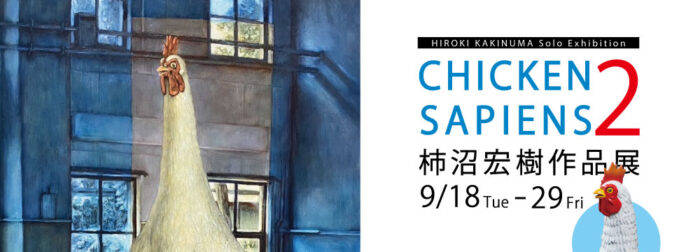
Hiroki Kakinuma: CHICKEN SAPIENS 2 — Celebrating the Second Figure Release
September 18 (Fri) – September 29 (Tue), 2026
Hori Ryokei. Born in Mie Prefecture in 1944. He joined Mitsubishi Petrochemical and worked at the Yokkaichi plant, the Tsuchiura research laboratory, a manufacturing plant in the United States, planning and sales at the Tokyo head office, and sales in Osaka, before retiring from Mitsubishi Chemical in 1999.
In 2000 he founded the Kashiwa Watakushi Museum, and in 2003 the Wa no Kai — an association of collectors who run “my own museum”. He is currently director of the Kashiwa Watakushi Museum and secretary-general of the Wa no Kai.
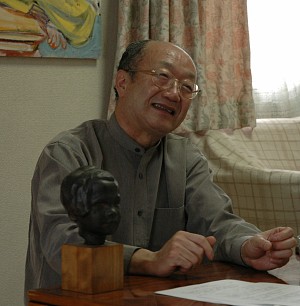
Hori Ryokei (below, Hori) The other day NHK filmed this museum for “Nichiyo Bijutsukan” (Sunday Art Museum). I was taken aback — why come and film us? — but they had not come because a private house had been turned into a museum. They came to film the works in our Tetsuya Noda exhibition. That made me happy.
Chiaki Tanaka (below, Chiaki) How many visitors do you usually have?
Hori We want people who genuinely love pictures to make the journey, so the museum is strictly by appointment. Roughly thirty to fifty a month. When the programme is a good one, about a hundred.
Chiaki That is a considerable number, then.
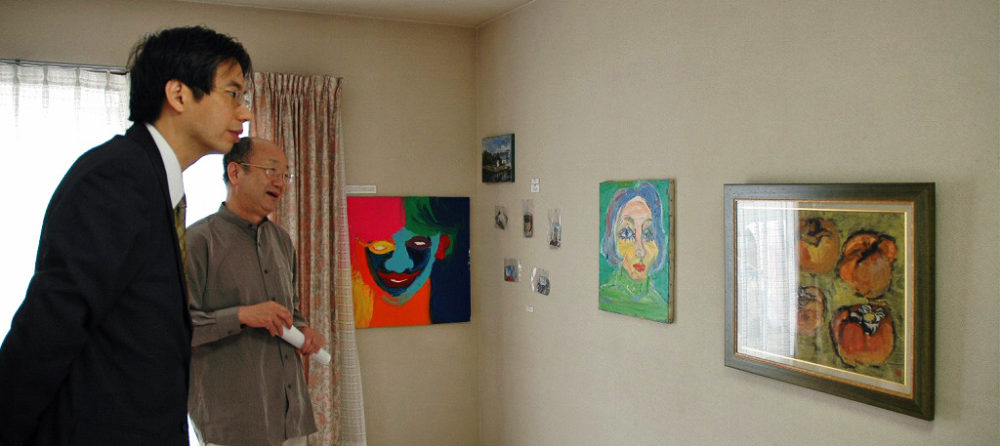
Hori If I wanted to make a profit I could open a tearoom or a restaurant and make one. But that is not what I want to do. I want to send something out from here to the whole country, as my own fulfilment, and I want people to see the pictures I own. I do this wanting to pass on the healing of the heart, the joy of looking at pictures. Once profit enters your mind you end up repeating the very thing I had come to hate in my working life in business, so I have decided not to chase it. I do this as something given back to society.
Chiaki I see. When did you start this?
Hori I left the company on 31 December 1999. What I had wanted for a long time — to stand on my own from January 2000 — came true, and the museum opened on 1 November 2000.
Chiaki I see. I hear you were an engineer before that?
Hori I began as an engineer, but as my head grew stiffer I spent twenty or thirty years in planning and sales at the head office. I was drinking every night to use up the entertainment budget, and I thought that if this went on it would kill me. I was worn out, so I quit.
Chiaki Ah, I see.
Hori More than that, I wanted to do something spiritually rich. If economic activity is the left wheel, richness of spirit is the right one, and I think it is when both turn that a person feels “it was good to have lived.” What supported that for me was my collection. So little by little I moved towards the richer side. But I did not want to look at the works by myself. Out of the wish to have many people see my collection came the Wa no Kai, and I want to pass on how enjoyable collecting is. Not only collecting — I want to pass on the pleasure of looking at pictures.