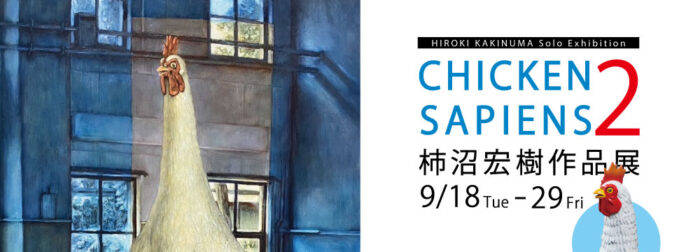
Hiroki Kakinuma: CHICKEN SAPIENS 2 — Celebrating the Second Figure Release
September 18 (Fri) – September 29 (Tue), 2026
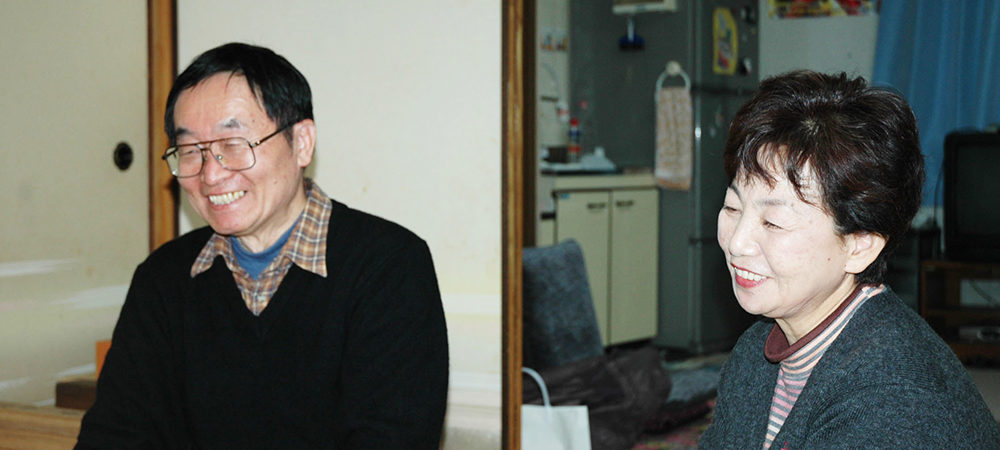
Introduced to us by Umeno Takashi, director of the Umeno Memorial Gallery, whom we interviewed last time, we went to talk to the Nihonga collector Shimomura Tamio. In twenty-two years of collecting he has gathered 1,300 hanging scrolls. We asked him about a collection of quite extraordinary size.
As a child Mr Shimomura was taken by his parents to the Kabukiza and the Bunrakuza. He was especially fond of Benkei in “Kanjincho”, and would imitate him to the amusement of the grown-ups. Under his mother’s influence he began going to the museums of Kyoto in his middle and high school years, and that seems to have been his first meeting with painting. After that he went mainly to exhibitions of Western art — a Dali show, a Rodin show — and he still remembers the impression made on him by Rembrandt’s “David and Uriah” at the Osaka Expo of 1970. Until he married he had seen almost nothing but exhibitions of Western painting and had no interest at all in Nihonga; and yet, in the spirit of “as Benkei collected a thousand swords, I shall collect a thousand hanging scrolls,” he arrived at a collection of 1,300. We went to ask how.
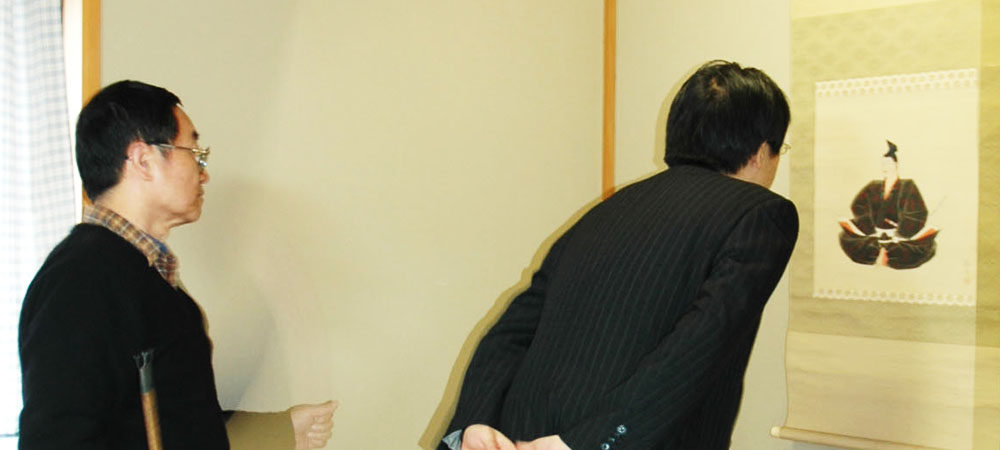
He showed us his collection, hanging one scroll after another in the alcove; and this became the first of our interviews in which the collector’s wife took part as well.
Chiaki I was introduced to you by a group of people who collect Western-style painting. Is there any circle or gathering only of people who collect Nihonga?
Shimomura Hmm — not really, and I have never heard of one. I don’t know why. People on the Western painting side seem to have all sorts of groups and gatherings, but a society of Nihonga collectors is something even I have hardly heard of.
Chiaki Is that so. It is strange.
Shimomura Why should it be? I have wondered about it myself.
Chiaki I have a feeling there are more Nihonga collectors in the Kansai than in the Kanto. Is that right?
Shimomura Kyoto has many antique shops and, I think, many Nihonga collectors; but in Osaka there are not many people collecting Nihonga.
Chiaki I see.
Shimomura Since last year a group of art lovers — people living in Osaka who like pictures — have got together, and two or three times we have made the round of exhibitions together, saying “let us go and see this one”, with my commentary. Even then most of them preferred Western painting, and since my own field is Nihonga I chose exhibitions where both could be seen. It is nothing much, but I hope to increase the number of Nihonga admirers starting close to home.
Chiaki Splendid. Has anyone come to take an interest in Nihonga because of it?
Shimomura Yes. Some say they have finally begun to see the difference between Nihonga and Western painting, and some have come to every single one.
Chiaki Is that so. By the way, where do you keep a collection of 1,300 scrolls?
Shimomura The scrolls are laid out all over the tatami room, so that the room has become a storehouse. And five closets are full as well.
Chiaki But that is possible only with scrolls. With Western paintings you could not manage a thousand.
Shimomura No. People who collect Western painting rent a flat for them. In that respect scrolls give no trouble to store, which is a virtue. It is a charm peculiar to the hanging scroll.
Chiaki Indeed. And where do you generally buy?
Shimomura I do not often buy from the big houses. In fact I know a great many brokers, and I would buy from them at a little above the price they would have taken to the market. Otherwise a salaried man could never build a collection like this. In my experience, if you have funds, your family’s understanding, a good adviser and honest dealers, the conditions are ideal. I found a conscientious dealer early on and asked a great deal of him — payment in instalments, holding a piece until my bonus came. To build a collection it matters to make allies who will help you. Above all, the understanding of the family — of one’s wife especially — may be the most important thing of all. In my case my wife had once studied Nihonga, so I have managed to do more or less as I liked; but it is worth taking your wife to an exhibition now and then, and treating her to dinner on the way home — some effort to make her fond of pictures. We often go to exhibitions together. A good collector, one might say, needs to take care to be a good husband.
(Mrs Shimomura Sawako appears at exactly the right moment. Below, Sawako.)
Chiaki Did you actually object?
Sawako Well — there was no way to object, was there. (laughs)
Chiaki Many of our own customers worry about their wives. Some say, “My wife would hate it, so I had better not.”
Sawako Well, it is not my stomach that aches over it.
Shimomura I made a good contract with my wife at the outset, you see. (laughs)
Chiaki There was a contract?
Shimomura No, no. We talked about how to keep the accounts, and I said I would pay the household expenses, a fixed sum out of the bonus, and everything for the children. In exchange, whatever I could put by beyond that was mine to use freely. And as I worked for an insurance company, investment was my profession, so I raised money in various ways and bought.
Chiaki At what age did you begin collecting?
Shimomura Twenty-two years ago, at about forty. We had been living in company housing; we bought a house of our own, and as it had an alcove I bought a scroll at a department store to hang there. That was the beginning. But it seemed wrong not to feel the season, so I began buying others.
Sawako I like pictures too and we often went to see them together. But I never imagined my husband would become so absorbed.
Chiaki Still, 1,300 is a formidable collection. Many people have quantity alone; collections where quantity is matched by quality are rare, and yours is a truly fine one. I hear you have even held an exhibition.
Shimomura At the Tanaka mounting shop in Osaka, with whom I am on friendly terms, they let me do it. Only a few could be hung, but it is a good memory. I consult that shop about remounting; knowing an honest mounter is another thing that matters in collecting.
Chiaki Indeed. But the visitors must have been astonished.
Shimomura They were. People who know Nihonga well would ask me what on earth I had done.
Chiaki A collection of more than a thousand scrolls is remarkable.
Shimomura At the beginning I bought anything and everything — the moment I thought something rather good, I bought it. So there are things among them that I would not show to anyone now. From partway on I meant to narrow it down to older and better things.
Sawako He went out every weekend. And came home carrying about ten scrolls. At first, every time he came back I would ask, “What did you buy today?” and listen to it all. He would say “this one is splendid!” and I would nod along. But before long it became “oh dear, he has come home with another armful,” and I began to worry about where to put them. There was no room left even for the bedding.
Chiaki Hang up a sign and you could open an antique shop. (laughs) Mr Shimomura, do you have any hobby besides collecting scrolls, or is it this alone?
Shimomura This alone, entirely. I do not drink much, I do not play golf. I do not gamble at all.
Chiaki Well, well — I should like my father, our chairman, to hear that. (laughs)
Shimomura I think it a waste to buy a single cup of coffee out, and yet I do not think it the least waste to pay several hundred thousand yen for one scroll. That is the collector’s psychology, I think. But it is not easy for my wife to follow.
Sawako Of course not. (laughs) Every morning I am comparing the flyers in the newspaper to see where something is ten yen cheaper. I cannot follow it.
Chiaki A man’s hobby and a woman’s supermarket sense do not generally agree. Even so, this collection exists because of your understanding.
Shimomura Still, better than drinking and spending money on women. (laughs) And drink leaves nothing behind; this remains.
Sawako I do hope there is something good among them.
Chiaki There is. I should like to make a catalogue of it and take it home with me.
Sawako Really. I am glad.
Shimomura But until I married I had been to almost nothing but exhibitions of Western painting, and had little interest in Nihonga. Or rather, I did not understand it.
Sawako I was the one interested in Nihonga. I wondered how one could paint like that, and — badly — I studied it for about a year before we married. We had a child soon after the wedding and the materials have stayed in the closet, but I like looking, and I think it was I who first invited him to go and see Nihonga. So I do not dislike it. At first I was glad when my husband began buying scrolls. It has never been a cause of quarrels.
Chiaki What was the first picture you bought?
Shimomura The first of the collection proper was a Suga Tatehiko. I set myself no theme and bought whatever came; if my own eye told me it was good I bought it on impulse. Though I am fond of yamato-e and of historical fiction, so there is a good deal of historical subject matter in my collection. Nowadays, when you hang such a thing, few people can tell what scene it shows.
Chiaki That kind of learning needs to come back in Japan. One would like to know the scenes of the Heike Monogatari and the Genji.
Shimomura The charm of the hanging scroll is that the whole feeling of the alcove changes with the scroll you hang.
Chiaki I ask everyone this: many people are satisfied to go and see pictures at a museum, but what do you think is the difference between only looking and actually buying?
Shimomura Well. Saying that looking is enough is, if anything, leaving it to others. You go because someone else says it is good. Buying a picture means buying because you yourself like it. So you will buy even an unknown artist if the work, the design, appeals to you. It may be a kind of self-satisfaction. In my case, in buying, I also want to introduce artists nobody knows, to discover them. And at an exhibition it is crowded and you cannot look properly, so buying the work of an artist you love and looking at it slowly whenever you like — that is the real pleasure of buying. My wife calls it pure selfishness. (laughs)
Chiaki (roars with laughter)
Shimomura But when you see a good work at an exhibition and wonder what the painter meant to say, and as the receiver you feel that it is just so — the moment when the painter’s heart and the receiver’s heart match is the greatest happiness there is. I want everyone to have that experience, which is why I gather a few people and take them round the museums with a commentary. To let people know how good pictures are, I have given scrolls as gifts to acquaintances for celebrations and farewells, and several of them have since come to me wanting to buy scrolls for each season. I think that is a fine thing. I want to increase the number of people who love Nihonga.
Chiaki How might one increase them?
Shimomura I wonder about that too, but first of all I should like people to build houses with an alcove. For Nihonga it must be the hanging scroll.
Chiaki Since the war, as more Nihonga has been framed, there is a sense in which Nihonga itself has become half-hearted.
Shimomura Yes. And, to speak plainly, Nihonga painters have grown less skilled. There are fewer works that appeal to the viewer. For people living a Westernised life, the yamato-e and history paintings on scrolls have nothing to do with them; they have become tales in a world unconnected with daily life. And, as I said, people no longer know the stories, no longer read them — a vicious circle. If one recognised a scene from a book read in childhood, one would look at Nihonga with far more interest. Today even what people read is all Western tales. I should like them to read more of the old Japanese stories.
Chiaki And Nihonga had the craftsman’s splendour of being able to draw a line, and that tradition has died out. Something fundamental needs to change.
Shimomura In the end I suspect there is some harm in the postwar education that prized individuality. The painters of the past were made to draw lines for years, made to draw circles over and over; they had that foundation. Today there is hardly a painter who can give a figure living eyes. To say there is none would be going too far, but they are few. In figure painting the eyes are extremely important.
Chiaki That may well be so.
Shimomura In Western painting you can paint over a failure; in Nihonga you cannot. So it matters, it is a duel in earnest — as my good adviser, the nanga painter Kamitani Noshu, often used to say.
Chiaki I went recently to see the Choju-giga scrolls. Essentially it is one go: you must draw the whole scroll through. It needs patience, and a great deal of practice so that on the day you make no mistake. That tension is peculiar to Nihonga.
Shimomura It is. A duel in earnest.
Chiaki People often say that galleries have an atmosphere hard to walk into. Is that so?
Shimomura At first I felt it too. I have long since grown out of it, but others do say so. I think it is better to go in with a certain brazenness. Still, the first impression is undeniably of a high threshold. In my case a school friend was head clerk at a gallery, and as I dropped in there again and again I became bold enough to walk into others.
Chiaki In fact a good many shops are unexpectedly easy-going.
Shimomura They are. Anyone about to start collecting should speak up freely.
Chiaki I suppose customers feel they must not be a nuisance when they are not buying.
Shimomura I think so. That is why I always go in saying, “May I have a look?” I tell everyone that is all it takes — but going in for the first time, everyone does feel some resistance. A gallery whose owner is young and bright and easy is easy to enter. Though I feel such galleries are few.
Chiaki Is that so. To change the subject — roughly what is the whole collection worth?
Shimomura Well, well… (after a silence, laughs) There cannot be many men who have done as they pleased to the extent that I have. I have been allowed my indulgence.
Chiaki Hard to say, of course. Finally, then, I should like to ask: in a word, what is collecting to you?
Shimomura In a word — “proof that I lived”, I should think. I used to say to everyone at the company, “As Benkei collected a thousand swords, I shall collect a thousand hanging scrolls.” Carrying one thing through to the end; a piece of proof that I did this. I did not want to end half-heartedly. I felt that when I had gathered about 150. Once, thoroughly, I would do it — I would collect. Some twenty years have passed since, and this is the shape the collection has taken. I may not have been much of a father, but this is my proof that I lived: look, I gathered these.
Chiaki Certainly one wants to do some one thing in a lifetime.
Shimomura Yes. I wanted to do what others do not, perhaps. It may sound a little affected.