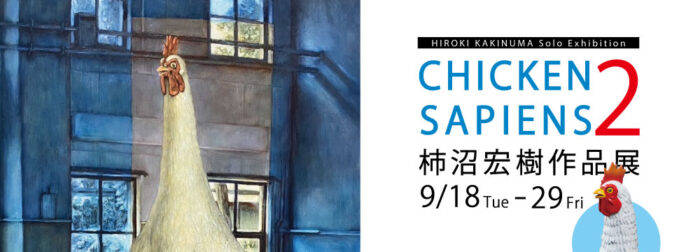
Hiroki Kakinuma: CHICKEN SAPIENS 2 — Celebrating the Second Figure Release
September 18 (Fri) – September 29 (Tue), 2026
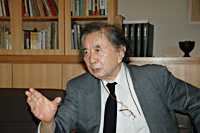
Umeno Takashi. Born in Yame, Fukuoka Prefecture, in 1926. Graduated in 1951 from Nagasaki College of Economics (now the Faculty of Economics, Nagasaki University) and joined Bridgestone Tire. In 1985 he stepped down as auditor of Bridgestone Tire Osaka Sales.
He then opened the gallery Geirin — Art Research Geirin — in Kyobashi, Tokyo. He published “Hunter of Beauty” in 1986 and “In the Forest of the Muses” in 1992, and closed Geirin in 1997. In 1998 the village of Kitamimaki opened the Umeno Memorial Gallery and Fureai Hall, and he became its director. After the municipal merger of 2004 it became a museum of the city of Tomi.
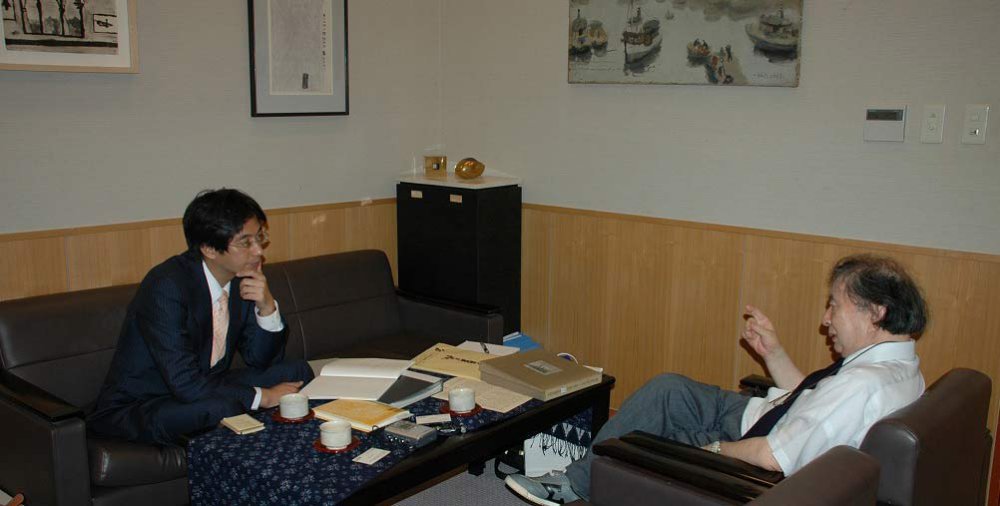
Chiaki Mr Umeno, what made you begin collecting?
Umeno I joined a company and started work in accounts, but accounting was not the work I wanted to do. I felt something out of joint, something unsatisfied.
At such times I would go back to my parents’ house, and there would always be three or so antique dealers there. They were all waiting for me. “Your father had the best eye in Kyushu — please bring out some of the ceramics,” they would say, and at a time when my salary was not even ten thousand yen they would pay some thirty thousand. But now and again there would be someone who set out to cheat me.
Chiaki Cheat you how?
Umeno They would say, “Won’t you trade this old pot of mine for the one you have?” Then I would take what I had received to a connoisseur, and be told that what I had taken in exchange was not old at all — it was a new pot.
I have the bitter experience of being palmed off with fakes like that. It was because I grew sick of it that I began to collect. But I thought ceramics were still too early for me; pictures, I felt, I could manage.
I had grown up steeped in the paintings of Aoki Shigeru and Sakamoto Hanjiro, so I had seen a good many pictures. I resolved that I would not be deceived again — that I would collect with my own eye.
Chiaki What was the first picture you bought?
Umeno The first was Ai-Mitsu’s “Thistle”. I had money from selling part of my father’s collection. What should I buy with it? I wanted to buy something good and not be cheated. And then I found a strange picture reproduced in the magazine “Bijutsu Techo”. I wanted that picture, so I telephoned the magazine, was given the family’s address, wrote a letter, and Ai-Mitsu’s widow Kie let me have “Thistle”. That was the beginning of my collection of pictures.
Chiaki I see.
Umeno This year, in the Ai-Mitsu exhibition, that picture was made into a postcard.
Chiaki Do you still have it?
Umeno No, that picture is gone. I fell in love with a certain woman, and I let it go to pay for a trip to Nikko. I wrote about this in my book “Hunter of Beauty”, and enough time has passed that I can tell you now. (laughs) Collecting is interesting precisely because your own private drama comes alive along with the pictures.
Chiaki In what way, concretely?
Umeno For example: this is the picture I met and bought when I was struggling at work. When I look at the pictures I have collected, a scene from my own life comes back to me.
One picture, and the memories come round like that. So when a rich man buys an expensive picture and puts it straight into storage to wait for the price to rise, I think what a dull thing that is. In my encounters with pictures there is the joy of the discovery, and the memory of the hardship, and the memory of hesitating between one and another — every single picture in the collection is packed with that drama. In every one of them is the memory of my heart’s search for a lover.
Chiaki Some people now seem to be buying pictures as an investment. What do you think about that?
Umeno People say that the back of a picture is a security certificate. If you ask what human desire everyone is interested in today, it is money. Most desires can be settled with money. People want money in order to satisfy their desires. I take a slightly different view.
I think there is something wrong with it. About pictures especially I am a purist. I love pictures purely. Having finished my life as a salaried man and reached retirement, I then took up the trade of the art dealer, which is the very battlefield of collecting. I opened Art Research Geirin in Kyobashi, Tokyo; since I could not pay the rent unless I sold pictures, I had no choice but to take out a dealer’s licence.
Chiaki Ah — I have heard of this from my father, our chairman. That you were dealing in Kyobashi, and that he was much indebted to you. Thank you.
Umeno At the time the dealers I knew were all against it: this is not something an amateur can do. But I had lived wanting to become “a man who can see beauty”, and in my fifties, when I was earning well, I was happiest of all. I could find and buy what I liked, one after another, with my own eye. In those days I bought up whole groups of works nobody knew — Nakamura Chuji, or Ita Yusei — directly from the families. And I began to make their names known.
Chiaki There are many people who like looking at pictures but never buy one. What do you think is the difference between only looking and actually buying?
Umeno (vehemently) Look — where something you love is concerned, not buying means you do not love it. If you truly love a picture, if you truly like it, I think you buy it. Many people look at pictures and do not buy, but I suspect most of them are looking in order to have something to say to others, or are looking without feeling anything.
If you feel without being moved, it is the same as not having looked at all. Beauty is my heart. My heart is what I myself long for.
In another person’s beauty I see the beauty I long for. When I find that I share the maker’s feeling, I cannot help buying.
And I can pick out the famous and expensive ones — I have looked at so many pictures and so many catalogues that I have an instinct for the genuine and the false. There are many unsigned things I have dug out. But to what I do not share a feeling with, I am indifferent. If you are buying for the value of the property, then of course you should seek out the famous and the expensive.
Chiaki I see.
Umeno …But lately I have tried to listen to the words of people who feel for the things I dislike. There is a great deal of beauty I have overlooked in what I most dislike.
I thought Kusama Yayoi’s work was interesting from her debut, but I also thought I did not like it — and then she grew more and more famous, and when I read what her admirers had written I found myself thinking, ah, I see.
Ah — so this is a beauty I missed. But at any rate, it is better not to buy what you dislike.
I try not to buy a picture merely because the painter is skilful, because the technique is good. I collect what I share a feeling with — and not only that, what carries the same clarity as my own feeling.
I long for what is pure. And good things, whenever I look at them, quietly console me.
Chiaki Do you have any advice on choosing a gallery?
Umeno A collector goes to a gallery wanting to see and to buy something good, so what the dealer has gathered because he likes it, and how he means to present it, you can tell at once by the smell of what is on the walls. What I think Syukado does well is that, unlike your father’s generation, you are in this trade with a fresh spirit. In particular, interviewing collectors in your catalogue and taking in what they say has become Syukado’s signboard. I have collected for a long time, and I have never heard of another gallery doing it. A gallery that balances a distinctive philosophy with sound management is a good gallery.
Chiaki Thank you.
Umeno Choosing a gallery is something you come to by yourself, and the galleries I go to are more or less fixed. The others I only look into. Which galleries a person visits is decided by that person’s taste and feeling. By the way, why did Syukado decide to interview collectors?
Chiaki I came into this world suddenly, so it was a simple wish to know how buyers feel — and I hoped I might find something that would be a hint for people who buy.
Umeno I feel that Syukado is interested in how far it can bring the ordinary collector onto its side, taking in a balanced way the fields where there are a good many such collectors.
In your father’s generation it was Nihonga alone; the Syukado of today has taken in Western-style painting as well, and I feel you are drawing in all sorts of fields.
Beauty lies fallen everywhere. I have longed for beautiful things of every kind, and all my life I have gone on searching with my own eye for that beauty which lies fallen. And because I have expressed myself, I have been fortunate enough to gather admirers little by little. That makes me happy.
Chiaki Indeed. You have a great many admirers. Mr Hori (see catalogue 9) told me that the Wa no Kai is really something like the Umeno fan club.
The Wa no Kai is an association of collectors who run “my own museum”.
Umeno When I started Geirin, I decided that in the very middle of Tokyo I would take my chances on what I loved. And I decided one thing.
It was that I would do something different from the dealers of the day. Essentially I would work with dead artists whom the dealers did not handle and the critics had overlooked. I had dealt with dealers for a long time, so I told myself: I will not do the bad thing. What is the bad thing? When I said at a gallery, “I want to buy this,” the dealer would say “take it” without even a deposit.
And because I love pictures, when told to take it I would take it away at once, and then meet the next picture I wanted, and the next, and carry them all home until I could not pay. (laughs)
Chiaki (roaring with laughter, then soberly) That would be a problem.
Umeno It would! And I thought there must be plenty of customers like me. So I never handed over a work until it had been paid for. I asked for a deposit as a rule, and I allowed payment in instalments over a year.
Chiaki I see. So that is how you did it.
Umeno Whether it was thanks to that or not, I never once had a bad debt. And it was a family business, with my wife and daughter. Apart from fixed deposits I never borrowed at all. The banks said again and again, “We will lend, we will lend,” but I never once borrowed. The times were also good while I was running Geirin. Today the trade faces a much harder environment.
If you ask what I was selling in my work, it was that I sought out with my own eye the artists who had been forgotten and buried, and made their names known.
I traced the families of dead artists I loved who had been buried, and held memorial exhibitions for thirty-three of them.
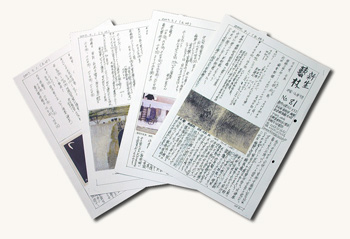
I shall not forget being able to hold, fifty years after their deaths, memorial exhibitions for Yoshida Taku and Matsushita Haruo, painters who died young. And when the gallery opened I began writing a monthly report, handwritten with photographs pasted in.
Chiaki That is the “Geirin Monthly Report”.
Umeno I have issued the Geirin Monthly Report since 1985, without missing a single month. I went on writing it after the Umeno Memorial Gallery opened; it now stands at number 269, twenty-two years of writing. It goes to our special members. Persistence is strength, and a good many collectors now read it. I had found things no critic had found, so I wanted to speak of my own beauty in my own words.
Chiaki You were running Geirin — and how did this memorial gallery come to be founded?
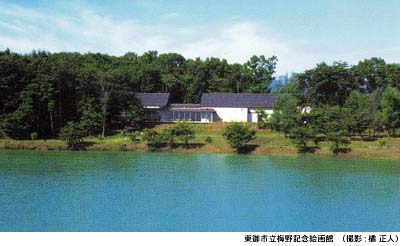
Umeno It was in the autumn of 1993 that I heard from Watanabe Takeshi, a member of Art Research Geirin, my gallery in Kyobashi, Tokyo, that an “art village park” was being built in a place called Kitamimaki Village in Shinshu, and that there were plans for a museum there.
I was soon to turn seventy, and I had been looking for just such a chance — to hang in a wide space the works I had gathered over so many years, to look at them, to show them all together and put their meaning to the world.
I visited the place, walked in the quiet park where woods and pond were in harmony, and met the cultural understanding and discernment of the village mayor, Mr Koyama; and I decided without hesitation to move my base to this village museum and to give the rest of my life to honouring artists who had died.
Mayor Koyama even gave it the name Umeno Memorial Gallery, so I promised to become its director and move to the village, and from two years before the opening I made a catalogue — an unusual one, in which everything but the artists’ biographies was written by me, recording my memories of the collection.
The Umeno Collection is the sum of two generations of picture collecting, my late father Umeno Mitsuo’s and my own. On the founding of the gallery I decided to give the village four hundred and thirty works from the collection, including more than fifty by Aoki Shigeru, who had been my father’s friend.
I think this collection is proof that, without a fortune of hundreds of millions, one can build a collection as individual as this if only one has a heart that seeks beauty and a sure eye. I think of it as my message to the lovers of art in this world.
Chiaki Yes, indeed.
Umeno There are very few public museums that bear a collector’s name. There are a few, but I think I may be the only collector who has entered a city museum and serves as its working director.
Chiaki I think you are.
Umeno I am no millionaire; I was only an ordinary salaried collector. We run this museum with the public authorities and ourselves together.
If this way of doing things succeeds, I think it may throw a stone into the question of what Japanese museums should be in future. And I mean to go on, patiently, with the art education the country failed to provide after the war.
It is small, but I want to keep at it. I am proud that the Umeno Memorial Gallery now has the largest friends-of-the-museum membership of any public museum in Nagano Prefecture.
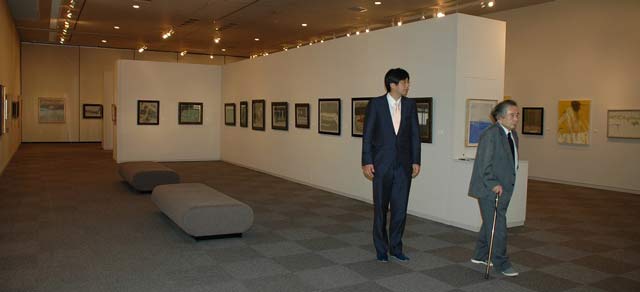
Chiaki I hear you hold something called the “One Beloved Picture” exhibition here.
Umeno Yes. We hold the “One Beloved Picture” exhibition through the friends’ association; this is already the seventh. Basically I would be glad if this exhibition spread to other regions.
But not with me as the commander. I would like someone to take up my thinking, and someone influenced by that thinking to hold it in all sorts of places.
I want to go on, in a small place, purely doing what I can do. It would be good if the person who does it feels that they did it, not that Umeno did it.
I think we would go wrong the moment we started thinking about setting up branches. Even small, I think it matters to continue purely. That is what I meant in the manifesto by a museum loved by its citizens and a source of their pride.
I am glad when the Wa no Kai and scholars join in and my activity spreads. The Nihon Keizai Shimbun even took up what we are doing (evening edition, 23 August 2007).
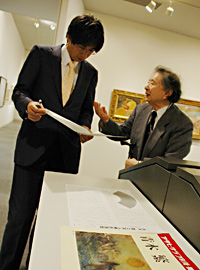
An exhibition of one beloved picture from each person’s own collection.
Chiaki What is the Umeno Memorial Gallery aiming at?
Umeno Our principles are, first, to be a gallery loved by the citizens. Second, to be a gallery that is the citizens’ pride. Third, to be a shining star among the museums of Japan. Those three.
Chiaki Splendid.
Chiaki Finally — for you, in a word, what is it to collect pictures?
Umeno Hmm. In a word it is difficult… I am a man who lives by loving pictures. Beauty is the nourishment of my heart. I cannot live without pictures.
It is hard to say in a word, but I live by collecting pictures. And if the pictures one has gathered have no individuality, it is dull. To collect pictures, too, is an art.