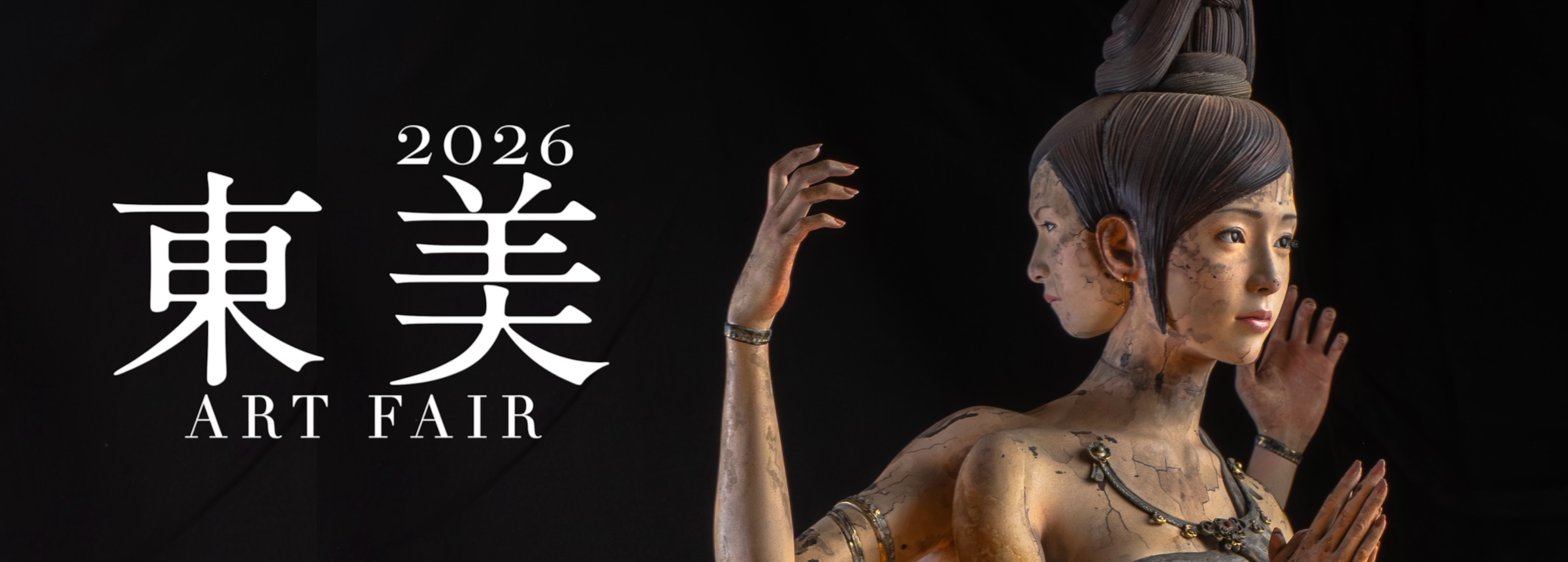
Gallery SHUKADO will be participating in Tokyo Art Club Fair 2026.
Our presentation centres on the sculpture of Masamitsu Kusenbo, who reinterprets Buddhist statuary through a contemporary sensibility, and places it alongside a wider range of work running from the modern period to the present day. Building on the forms of traditional Buddhist sculpture, Kusenbo has developed an idiom of his own that draws in the figure of a composed, dignified woman. Gold leaf is scraped back and the surface coloured so that it appears deliberately weathered, giving each piece the presence of an old devotional image that has passed through a long span of time, and asking what prayer and the life of the spirit might mean today.
Shown together with these are works by leading modern Japanese artists no longer living, and contemporary work by Ayaka Hatakoshi (ceramics), Hana Ikushima (ceramics) and May Masutani (glass).

Gallery SHUKADO will be participating in Tokyo Art Club Fair 2026.

Our presentation centres on the sculpture of Masamitsu Kusenbo, who reinterprets Buddhist statuary through a contemporary sensibility, and places it alongside a wider range of work running from the modern period to the present day. Building on the forms of traditional Buddhist sculpture, Kusenbo has developed an idiom of his own that draws in the figure of a composed, dignified woman. Gold leaf is scraped back and the surface coloured so that it appears deliberately weathered, giving each piece the presence of an old devotional image that has passed through a long span of time, and asking what prayer and the life of the spirit might mean today.

Shown together with these are works by leading modern Japanese artists no longer living, and contemporary work by Ayaka Hatakoshi (ceramics), Hana Ikushima (ceramics) and May Masutani (glass).

Exhibition Information
ExhibitionTokyo Art Club Fair 2026
DatesOctober 16 (Fri) – October 18 (Sun), 2026
VenueTokyo Art Club (6-19-15 Shimbashi, Minato-ku, Tokyo)
HoursFri, October 16: 10:00 - 19:00
Sat, October 17: 10:00 - 18:00
Sun, October 18: 10:00 - 17:00
NotesGallery SHUKADO, booth 3-32
Admission: 1,500 yen in advance / 2,000 yen at the door (tax included)
Masamitsu Kusenbo
Kusenbou Masamitsu was born in Hokkaido in 1974. Graduated from the Graduate School of Education, Hokkaido University of Education. He is now an active art teacher in the middle school. Beside work he has begun to make buddhas figures which absorbed huge attention among public thru twitters and other SNS. In 2019, he got “Grand Prix” of “Hakodate, Winter, Art Exhibition Awards”.

We could say that Buddha figures made so exquisitely could be ascribed to idealistic symbol of female figures. His sculptures are neither like realistic buddhas figures nor real female figures. They express just universal beauty and holiness.
Ayaka Hatakoshi
Born in Nagano, Japan in 1995. Graduated from the Ceramics Program at Musashino Art University in 2017. Focusing on rhythms and memories that emerge from relationships between things discovered in everyday life, she creates works centered on the idea of membranes that capture the presence of inner spaces, including installations using perforated ceramics and thin fabrics.
Major exhibitions and projects include Touching the Bottom (Matsuchiyokan, Aichi), part of the Aichi Triennale regional program in 2024, and SHINBISM 6 (Former Fujiya Ryokan and Hiraide Museum, Nagano) in 2025.
Hana Ikushima
Hana Ikushima was born in 1997 in Kanagawa and is currently based in Tajimi, Gifu Prefecture, working as a ceramic artist.
She creates both functional works such as teapots and cups, and sculptural pieces that transcend utility, exploring flowing beauty and structural tension within form.
She believes that vessels like teapots and yunomi are not merely tools for daily use, but tactile sculptures that refine the senses through touch.
By engaging closely with the material’s inherent qualities and expressions, she pursues quiet forms that embody stillness and dignity.
May Masutani
May Masutani is an artist from Singapore living in Toyama, Japan.
May uses glass to convey the ephemeral and transient quality of moments between people and their interactions with the surrounding environment. There is an underlying theme concerning human nature and the subconscious mind in her work. Although a seeming nothingness, she views it as a place of transition where things simultaneously come into existence and ceases to be. She sees this as a silent and unspoken communication that happens between individuals and comprehensively in the natural world. She has a notion that people possess an imperceptible aura that serves as a shared, mutually understood language.
May employs minimalistic forms which are both balanced and dynamic, with internal structures continually transmuting as the viewer moves around the work. The subtle hint offered through this optical play represents the intermediate space that is ever shifting, constant in its changing.