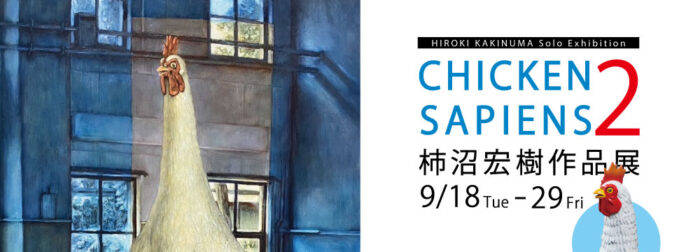
Hiroki Kakinuma: CHICKEN SAPIENS 2 — Celebrating the Second Figure Release
September 18 (Fri) – September 29 (Tue), 2026
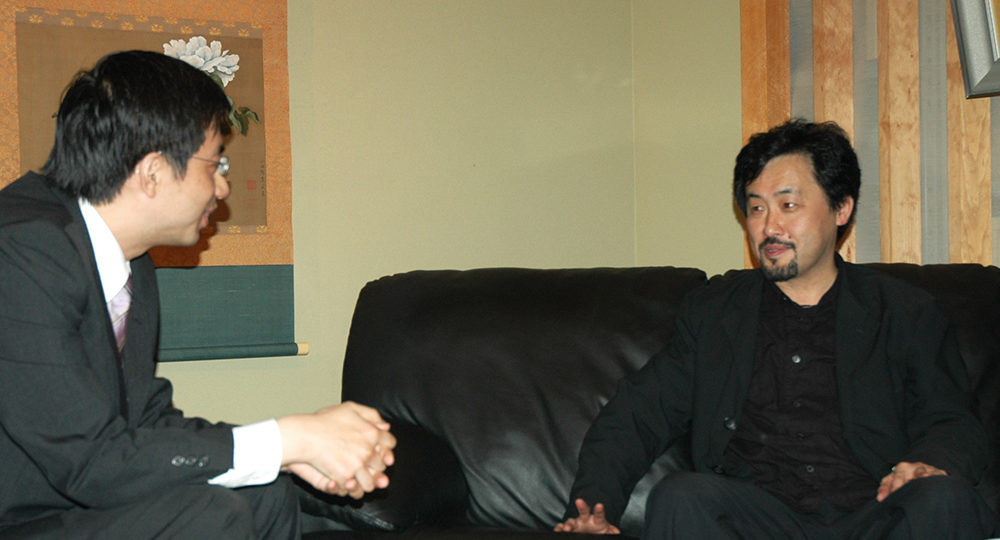
Our guest this time is Yamashita Yuji.
His own field is ink painting of the Muromachi period, but through the “Nihon Bijutsu Oendan” (Japanese Art Supporters’ Club) series written with Akasegawa Genpei — they are enormously entertaining — he has introduced the world of Japanese art from a fresh angle. He is also deeply versed in what is called contemporary art, turns up at galleries and exhibitions of every kind, and buys work himself.
His own field is ink painting of the Muromachi period, but through the “Nihon Bijutsu Oendan” (Japanese Art Supporters’ Club) series written with Akasegawa Genpei — they are enormously entertaining — he has introduced the world of Japanese art from a fresh angle. He is also deeply versed in what is called contemporary art, turns up at galleries and exhibitions of every kind, and buys work himself.
— Besides your research in early art, we hear that for some years now you have been going round the galleries, mainly for contemporary art, and that you often buy works. As a scholar it would be quite enough to look. Why did you go as far as buying? Please tell us your reasons.
“Most of what I buy is by young artists who are hardly recognised at all, and I buy as an expression of respect for those people and their talent. And as encouragement.
My work is writing, and respect and encouragement can be expressed in writing too, but buying goes further than that. Among people who write about art there are those who buy and those who do not; for the last six or seven years I have made a point of buying.
Of course I would buy in my own field of early art if I could, but the things I actually study would cost tens of millions, hundreds of millions. Quite out of reach.
I would like to buy two or three Edo-period works myself, but for that I would have to write a book that sells hundreds of thousands of copies (laughs). Whereas a young artist’s work can be had for fifty or a hundred thousand yen, and that really is a pleasure. In my case there is a sense of duty in it as well.”
— Buying is the strongest form of communication, isn’t it.
“It is. And they are genuinely delighted. Buying the work of an artist nobody knows is the best of all. That is why I walk around looking so hard.”
— And you look at older work with the same eye.
“I do. So even with work of the past, finding a value nobody has recognised and introducing it is, I think, the role of us art historians — though lately people have stopped calling themselves that.”
— Has anything changed in you between before you bought and after you began?
“I was hardly looking casually before, but the seriousness with which I look at a picture has certainly increased. When I was young I had no money at all and never even thought of buying a picture; now that there is a little room, looking with the thought that I might be able to buy it makes me more serious.
Though it is an odd thing to say, in my case once I have bought it I rather lose interest. Often it stays at the gallery. Or it stays with the artist. Then a loan request arrives from a museum, I stamp it and send it back, and one day the thing is hanging in the museum. Sometimes I have forgotten what I bought. I keep thinking I had better make a list (laughs).”
— But when you walk everywhere in earnest, from museums to galleries, you do run into it — into talent.
“You do. Yes — there are gifted people in every age.”
— Then let me ask about the works you have bought. In “Kongetsu no Kakushidama” (This Month’s Hidden Ball), your series in the monthly “Bijutsu no Mado”, you introduce young artists. Are they really all people nobody knows?
“Yes, almost all of them are people nobody in the world has heard of.”
— And yet, among those you introduced — Maehara Fuyuki (b. 1962), who carves astonishingly precise, utterly real wooden pieces on subjects like a bar of soap or bathroom tiles — I had simply assumed that anyone making work that extraordinary must already be known.
“No, he was quite unknown. But he really is remarkable. He may be the most remarkable artist I have met in the last five or six years. The article led to his being written up in AERA and elsewhere.”
— The others you have introduced, Fukatsu Shinya (b. 1957) and Akatsuka Michiko (b. 1973), also seem to be serious people, without any showmanship.
“That is how it has turned out. So many of them are truly good people, fine young men and women (with feeling). And you can tell from the work.
What I want to do is this: the art world looks far too much at nothing but guaranteed value, so I mean to do the exact opposite. Not the world of so much per unit of canvas.”
— Now, to change the subject a little: was there anything in our catalogue that interested you?
“Nanga is not to my taste, but this Kyou (No. 1 in this catalogue, Hoashi Kyou, “A Taoist in His Cave Dwelling”) is good. I would want this.
What I dislike about the world of nanga is that they seem to have made their own rules and to work only inside them. Infatuated with China without ever having been there. Though the contemporary art world is much the same — the crowd forever telling you what is happening in New York just now.”
— If nanga is no good, then what about Tomioka Tessai?
“No, Tessai is different. Why? Because he is thoroughly playful. He has all that learning and has digested what came before him, and yet he is somehow off-centre. That is the playfulness.
Fuse Kantaro (a physician, founder of the Fuse Museum, known for his Tessai collection), who gathered his work — he too was buying out of respect, was he not. But quite apart from that a market grew up around the brand, and forgeries began to circulate.”
— And among artists from the Meiji period onward, is there anyone who deserves more light?
“Yes, a number. Meiji crafts will surely come to be valued. In painting too there are many who will have light thrown on them. To take my own purchases, I bought a Watanabe Seitei (Nihonga painter and designer, active in Meiji and Taisho) — one piece.”
— With work by someone already dead, since the person is not there to receive it, is there not less point in spending the money as an expression of respect?
“Not at all. It is no different as an expression of respect.”
— To change the subject again: for an ordinary person it takes courage to push open a gallery’s heavy door. Could you give us some knack for it?
“It is simply a matter of treating it as shopping. That is all there is to it. …Though if we are talking about shopping, ordinary people are made to feel that the threshold is high. So what I would suggest to dealers is that they might think a little more about display.”
— Then let us hear your hopes, or your complaints, about the art trade.
“If I am to say it, then as I have been saying all along: everyone judges things by guaranteed value alone. Which turns into a way of distributing work by the unit, like selling by weight. Lithographs by Nihonga painters circulate at outrageous prices, do they not. That is a little strange.”
— When lithographs first appeared on the market I thought it would become a frightening business: the number and the range of “art dealers” would grow, and an enormous amount of money would flow in. “A market with no foundation came into being. …Though art always has an element of fraud about it. Sen no Rikyu (the founder of the three Sen tea schools; he served Toyotomi Hideyoshi and was finally ordered to take his own life; utensils in the ‘Rikyu taste’ still change hands at extremely high prices) may have been the greatest swindler of all.”
— Giving an extraordinary seal of value to an Ido tea bowl, to ordinary everyday ware. And it is remarkable that the valuation has held to this day.
“Well, the form remains. Though I know people in the tea families, and those among them who understand what they are doing are trustworthy. …Not only in tea: a picture, physically speaking, is only pigment or ink laid on silk or paper, and if you ask what of it, then yes, you could call it fraud.”
— Yes.
“But I want it to be fraud committed with one’s belly settled. Not petty fraud. In so-called contemporary art there is a great deal of knowing fraud going about.”
— Today it seems that only the pictures by people who can explain themselves become expensive, and that things move for reasons unconnected with the power of the picture itself.
“And self-presentation. Andy Warhol (the standard-bearer of American pop art in the twentieth century) — his prices run into the hundreds of millions, and he sold those trivial pictures as a knowing performance, using the media and all the rest. But he was conscious of it as a strategy. Today there are far too many easy-going authorities. And the same goes for the people dealing in it.”
— They lack the tension of knowing that they are giving a performance.
“Just so. I would like that resolve.
Speaking of easy-going authorities, the old Kano school (the official painters’ line that ran from the Momoyama period to the end of the Edo shogunate) was the same. The Kano school from Kano Tanyu (founder of the Edo Kano line) onwards. Drawing a salary from the lords. Which is why most Kano school work now goes for next to nothing.
And yet even within the Kano school there were a very few who painted with tremendous tension.”
— Kawanabe Kyosai (the last runner of the Kano school, active from the end of the Edo period into Meiji), for instance.
“Exactly. He had his pride as a Kano man. And on the other hand he apprenticed himself to Kuniyoshi. The work is astonishing. A most interesting man.
One must not decide that a picture is dull merely because it is Kano school.
…So the genre is beside the point. Past or present. What matters is how you meet the thing one to one. Anyone bound by so much per unit is not meeting the work one to one. The world’s valuation is really beside the point. Of course, among those who came before there were people who saw extraordinarily well, and there is much to learn from how they saw; but after that you must meet the thing one to one with your own eye. Otherwise you have not made contact with it at all.”
— In that sense, is the trade thoroughly poisoned by this business of price per unit?
“I am sorry to say it, but I have to say so. Though of course there are people who, while going along on the surface with the world’s valuation, are burning to meet the work one to one. With such people one can have a good relationship.
The same is true of collectors. Fukutomi Taro (proprietor of cabarets, well known as a collector of bijinga and of war paintings) is remarkable, I think. His collection has a thread running through it. He meets all sorts of things one to one.”
— …Speaking of bijinga, are you interested in Nakamura Daisaburo?
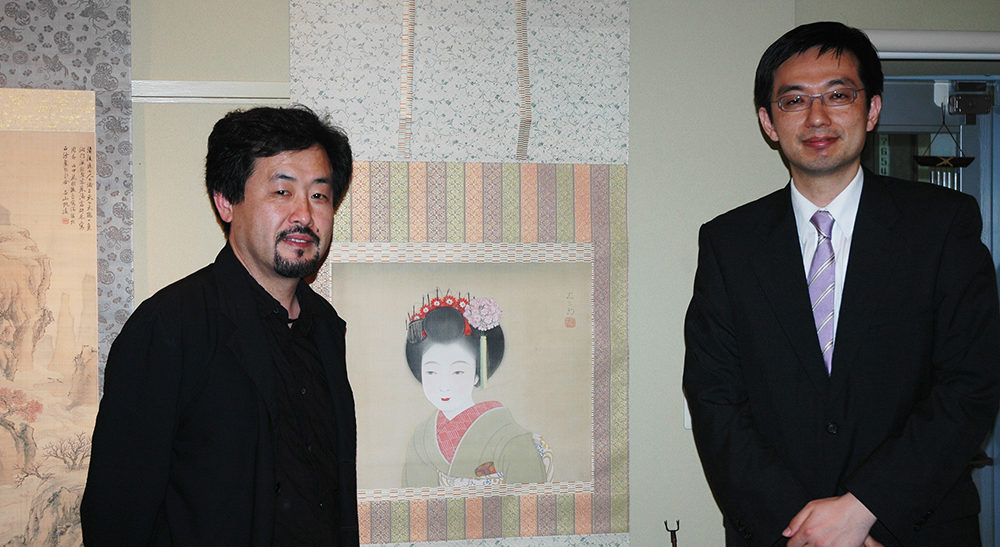
“Not in Nakamura Daisaburo, no… (we show him the actual “Maiko” published in Vol. 3) This is good. This is a picture I would want. If I had the money with me I would buy it.”
— That one I bought myself. There is a small flaw, but that mattered less to me than that it is a good picture.
“Then that means you met this picture one to one, does it not. Meeting one to one — that is today’s key phrase (laughs).”