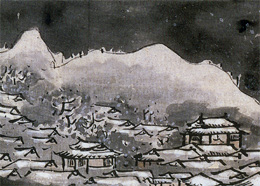
Little is known of his childhood. At about twenty he went to Edo and began to make his name as a haikai poet. He travelled the provinces, and in later life settled in Kyoto. His painting is said to have reached maturity around the age of sixty-three. He opened a territory of his own in haiga — spontaneous, light of touch — while in landscape his colour grew ever more refined. The final accomplishment of his painting came at the very end of his life in his command of ink tone: a contrast of white and black which, in conveying even the air and chill of night, marks out a pictorial manner of Buson's own, distinct from both Nanga and haiga. A strong leaning towards Daoist thought has also been noted as underlying his work.