Art Jakarta 2026
October 2 (Fri) – October 4 (Sun), 2026
At the head of this column I said that Fukutomi Taro was my master in spirit.
The painter most closely bound up with Fukutomi is Kaburaki Kiyokata.
He was, I think, the painter Fukutomi held in the highest regard and felt closest to.
Related: Bijinga column, Prologue
As I said in an earlier piece, it was without doubt Uemura Shoen who raised bijinga to the standing of a lofty genre; but the one who put warm blood into it was, above all, Kaburaki Kiyokata.
Related: Bijinga column, Uemura Shoen 1
Related: Bijinga column, Uemura Shoen 2
Shoen’s women are beautiful. But it is a beauty like a virgin’s: hard, drawn tight, fragile, with a tension about it that forbids touching.
Kiyokata’s women are a little looser.
There is play in his brush, and sometimes the line even breaks down. But there is the smell of a living woman’s daily life in it. So, to be honest, it is Kiyokata I feel close to. And there is this as well: Kiyokata stands for Tokyo and Shoen for Kyoto. The centre of elegant culture may be Kyoto, but do us the favour of looking at the style of an Edo man too.
Both lived from Meiji into Showa and both often took the manners of Edo and Meiji as their subject; but the one who watched the women of his own day — the theatre included — more closely and with more affection was, I think, Kiyokata. His is a world that dissolves into the scenery of the city and the manners of ordinary life, and is at home with literature.
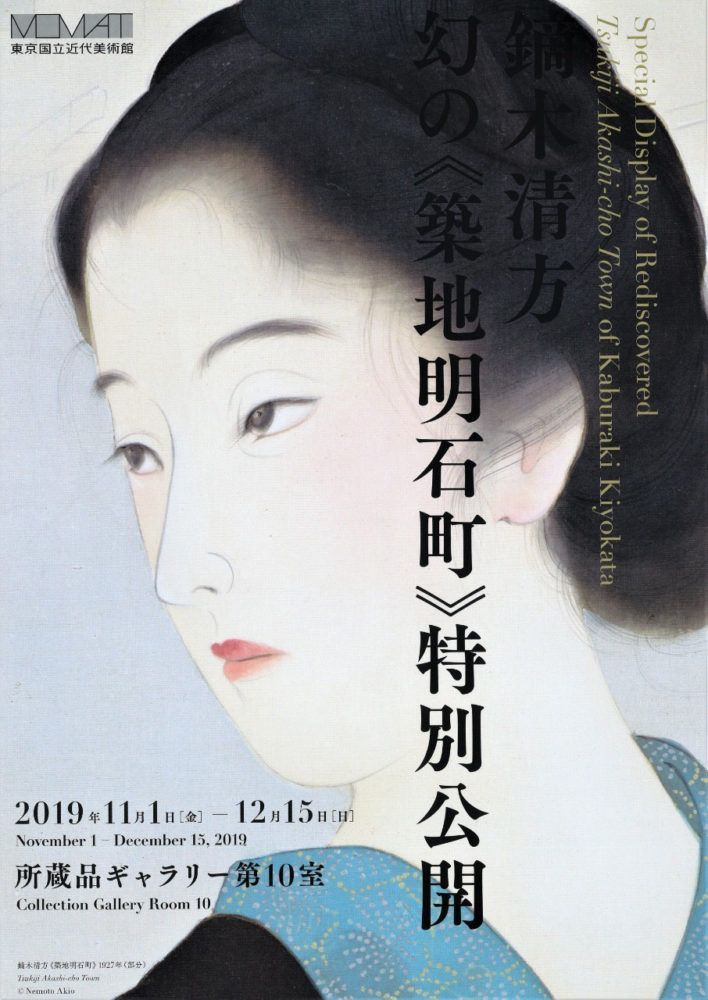
Look at the woman in one of his best-known works, “Tsukiji Akashi-cho”. This woman in the black haori is plainly no longer young — you can see it in the way her hair is dressed and in the lines added to her eyelids. But in the glance back over her shoulder and in the firmly closed mouth one feels the will of a woman who has lived, and a presence that is certain. The stray hairs at her neck, carefully painted, carry both the sense of a life and its allure. Not the abstracted beauty of ukiyo-e and everything before it, but a particular individual: was this not exactly the moment at which bijinga met the single person?
The picture is said to have had a real model, and when Kiyokata’s brush is given a particular individual it is at its sharpest, and draws out a presence that catches the breath.
Kiyokata held severe views about an exhibition art dominated by large works, and saw the proper line as beauty enjoyed close at hand. Having worked chiefly as a novel illustrator when he was young, he knew exactly not merely how to paint a woman but within what setting and what story she should be painted. His refusal of coarse-grained art shows a life lived in the belief that there is no true beauty in a large empty surface that has forgotten such fine attention.
So it was that what Fukutomi loved was not Shoen of the west but Kiyokata of the east.
Look at Kiyokata’s work again and again, and the true world of bijinga comes into view.
I am the second head of SHUKADO, and the third generation of the Tanaka family to deal in art. I grew up close to art and to old painting and calligraphy, but when I was young my interest was almost entirely in the cinema. Since I began working in art I have often thought what a waste those years were, spent without knowing how rich a world this is. Drawing on my earlier work as a systems engineer, and on the manual work before that (does film count?), I want SHUKADO to be an art company that is intelligent, expressive and warm — where the work and the welcome come from every member of staff, each putting their whole heart into it, rather than from one person alone.