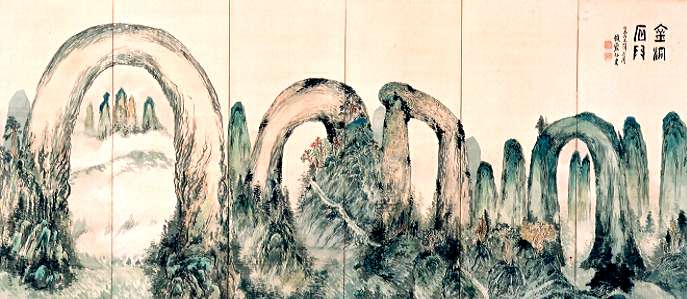
From about the age of fifteen he studied kokugaku and the Chinese classics, and was then taught painting by Setsuo Kubota and Nanko Ozumi of the combined northern and southern schools; later he studied under Kaisen Oda of the Southern school and Ikkei Ukita of yamato-e. In 1861 he went to Nagasaki and saw Ming and Qing painting at first hand; the following year he opened a private school, making his living by painting and calligraphy while busying himself with the affairs of the nation. In 1869 he became a teacher at Ritsumeikan and came to be known as a scholar. In 1882 he moved to Kusuriyacho in Kyoto, where he lived for the rest of his life, putting into practice the ideal of “reading ten thousand books and travelling ten thousand leagues”. He worked hard at copying Ming and Qing painting and yamato-e, and continued towards a modern revival of literati painting. In 1894 he became an adjunct professor of ethics at the Kyoto Municipal School of Art, and in 1897 took part as a councillor in founding the Japan Southern School Painting Association, showing at its regular exhibitions. In 1914 he made “Abe no Nakamaro Viewing the Moon at Mingzhou / Master Entsu in Retreat at Wumen” (Important Cultural Property).