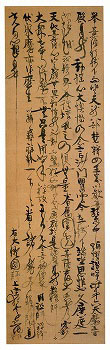
A Zen monk of the Daitoku-ji branch of the Rinzai school in the Muromachi period, said to have been a natural son of Emperor Go-Komatsu. His childhood name was Senkikumaru; he used the names Kyounshi, Katsuro and Mukei. At six he entered Ankoku-ji in Kyoto and took the name Shuken. In 1410, at seventeen, he became a disciple of Ken’o Soi and changed his name to Sojun. In 1415 he became a disciple of Kaso Sodon, a senior monk of Daitoku-ji in Kyoto, and was given the religious name Ikkyu. He then travelled widely and completed his Zen training. In his last years he became abbot of Daitoku-ji; he did not live at the temple, but worked to restore it. Fiercely independent and hostile to authority, he lived among ordinary people and was known for his eccentric conduct. His way of life, unbound by precept or form and full of human warmth, gave rise in the Edo period to the Ikkyu-banashi, tales of his wit. His writings include the poetry collections “Kyoun-shu”, “Zoku Kyoun-shu”, “Jikai-shu” and “Gaikotsu”.