Genpei Sakata Solo Exhibition
December 11 (Fri) – December 19 (Sat), 2026
After Uemura Shoen, Ito Shinsui and Utamaro, it is about time I introduced our hero.
Kainosho Tadaoto. The name is read Kai-no-sho Tada-oto.
If Utamaro made the category called bijinga, Shoen made the world at large acknowledge its authority, and Shinsui took it over with ease, then Kainosho is the man who brought the self into it. The self … a bit stiff, that? If not the self, then call it a reckoning.
Meaning: look here, people — women too — are not all beautiful, you know. Want to be lovely, want to be lovelier, want to be lovelier than the next one, want to be wanted, want to be looked at, want to hide what is ugly, want a better time of it than everybody else; a department store of ego, that is what it is. Men are ruled by their appetites, and women have much the same appetites and much the same ego. That is the reckoning he makes.
The story is well known: Tsuchida Bakusen called Kainosho’s pictures filthy and refused to have them in the open exhibition. And it is true that his pictures are dirty. But look closely at that dirtiness and you find the moment at which bijinga woke up to realism. The white-painted faces of courtesans and apprentice geisha are certainly beautiful, but somewhere along the way the face has become a sign that reads “beautiful”. Obediently, the paintings of the genre went on painting that beauty; but a generation like Kainosho’s, who had felt and thought about the depths of the human mind through Taisho democracy and through literature, could not go on with it. They wanted to see the true thing. They wanted to see the raw human being hidden under the finery.
So Kainosho would not settle for the sign, and painted the real face under the white paint.
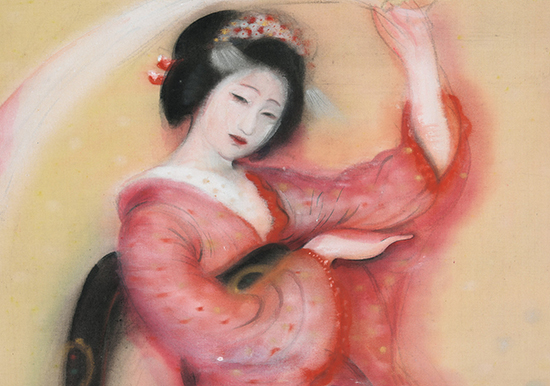
But that was a moment which came one step closer to us, who are by now used to seeing through the back of the back of the back of a person’s mind. And one can put it this way too. To say you like beautiful women is to say you do not like women themselves. You like her while she is dressed up and composed and quiet, and you will not take on the mind that may be calculating this and that. So his work is also a bijinga that asks: and the truth under the finery, the dirty truth — do you like that as well?
Kainosho, who made his name with such filthy pictures, was described by Kishida Ryusei as derori — and he meant it well. In fact, though, not all of his work is like that. A good deal of it is fairly temperate, and the late paintings of prostitutes are quiet enough in handling. His work cannot be said to have been made to answer a market demand for bijinga; he turned to work in the cinema and was obliged to stop painting for a long time, so the number of works is smaller than one might expect. And the so-called derori pictures are not so many either.
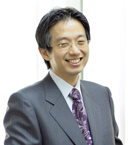
I am the second head of SHUKADO, and the third generation of the Tanaka family to deal in art. I grew up close to art and to old painting and calligraphy, but when I was young my interest was almost entirely in the cinema. Since I began working in art I have often thought what a waste those years were, spent without knowing how rich a world this is. Drawing on my earlier work as a systems engineer, and on the manual work before that (does film count?), I want SHUKADO to be an art company that is intelligent, expressive and warm — where the work and the welcome come from every member of staff, each putting their whole heart into it, rather than from one person alone.