Genpei Sakata Solo Exhibition
December 11 (Fri) – December 19 (Sat), 2026
Kitano Tsunetomi was mocked by the painters of his own day as belonging to the devil’s school. Whether they meant his strange way of making a picture, said with some envy, or a certain eccentric character, is not clear; but abuse from one’s contemporaries usually turns into an attractive catchphrase in a later age — much like the “blurred style”, first used ironically as a criticism thrown at Hishida Shunso and Yokoyama Taikan.
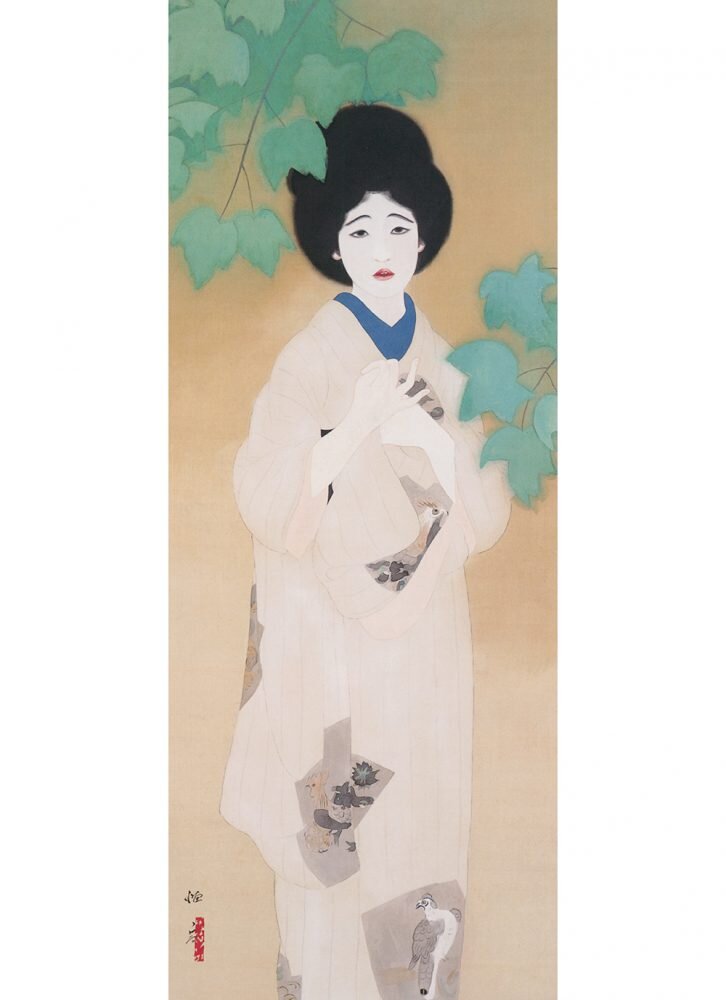
Hearing “devil’s school” with no context, a person today is more likely to imagine an attractive bijinga. One thinks of the femme fatale, the little devil of a beauty; at any rate a beautiful woman with charm enough to disturb the moral order. It matches well enough the strangeness of the women Tsunetomi painted.
But was Tsunetomi himself devilish? Not in the least. He seems rather to have been a painter of thoroughly earnest artistic temper, correcting himself again and again on the pride and the discipline proper to one who paints Japanese painting and the human figure. The more earnest a man is in anything, the more he is mocked by the idle conservatives of his own day: that is the way of the world, and perhaps some of Tsunetomi’s constraint came from there.
He left a good many statements as a painter, and, like Kaburaki Kiyokata, who preferred the word “genre painting” to “bijinga”, he is said to have somewhat disliked being called a painter of beautiful women. He should be called a painter of the figure, he thought.
Like Kiyokata, Kitano Tsunetomi worked as an illustrator of stories; and the work he did that Kiyokata did not is poster painting, for drink and for medicines. It is his posters, held to be his representative work, that Yasumasa Morimura restaged in one of his impersonations, and that Yasunari Ikenaga discussed in the May issue of the monthly Gekkan Bijutsu this year. They are as attractive as that. That he was a painter working to commission and a painter for the public seems, from our vantage point, rather to his credit; and of course he had his pride. But at the same time, as an artist, he appears to have been troubled by the harm done by letting a body of work be defined by the single word bijinga.
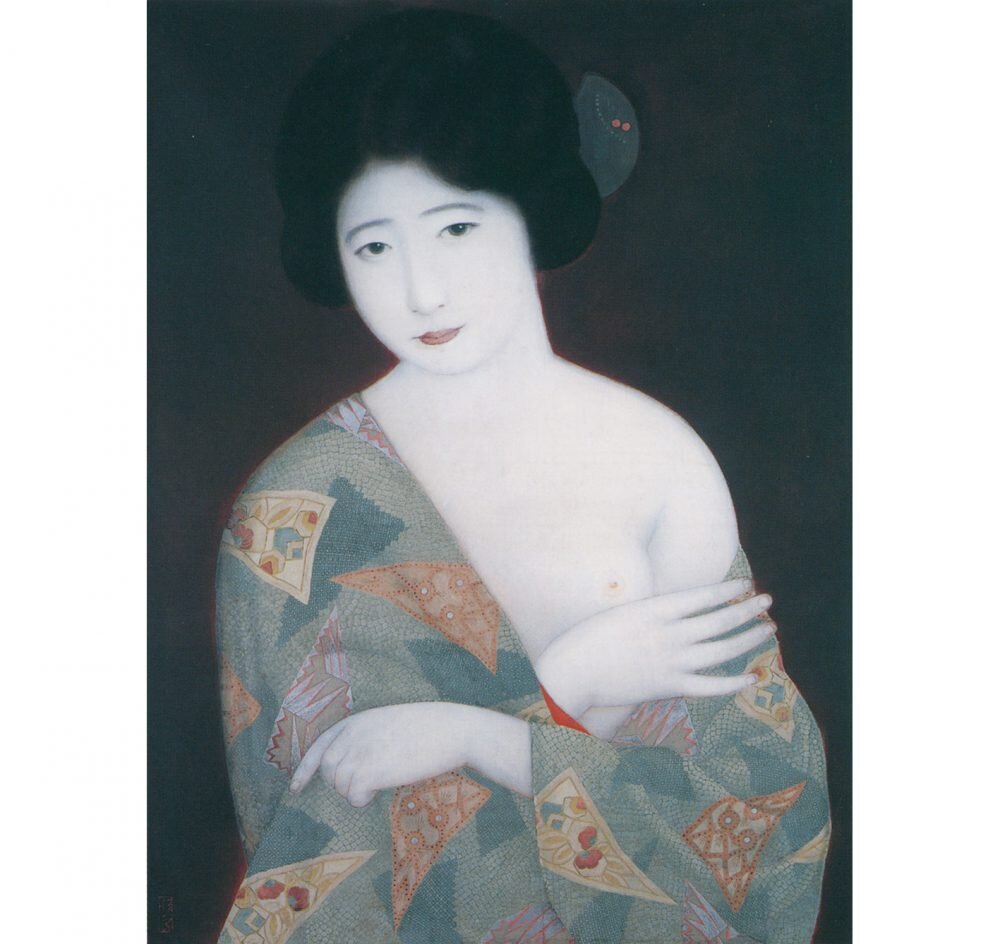
That struggle seems to me to matter a good deal in that period. For once art is captive to a genre, it refuses to develop, falls into type, settles into formula, and in time dies out. That the figure was hardly painted after the war might be said to be Tsunetomi’s fear come true.
Whether because of that awareness or not, Kitano Tsunetomi has no fixed type for painting a beauty. The posters have faces of a realism closer to oil painting; there are the round-faced, black-eyed beauties of the prints; there is the well-known heron-maiden motif, a beauty somewhat in Kiyokata’s manner; there are the grand Japanese-painting beauties of the daughters of wealthy Osaka. The type of the face differs in every case.
That is the opposite of Takehisa Yumeji, Kaburaki Kiyokata and most painters of the genre, who have a face of their own; and it has, unfortunately, left Tsunetomi’s work rather indistinct.
With ukiyo-e artists, with cartoonists and with Japanese-style painters, the face does sometimes change from period to period; but it is not common for the modelling of the face to keep changing regardless of period. Why Tsunetomi’s beauties keep changing shape is not clear; but the pictures that come onto the market include astonishing masterpieces and unexpectedly ordinary things, and the faces differ so widely that one has to say it has held back the settling of his reputation today.
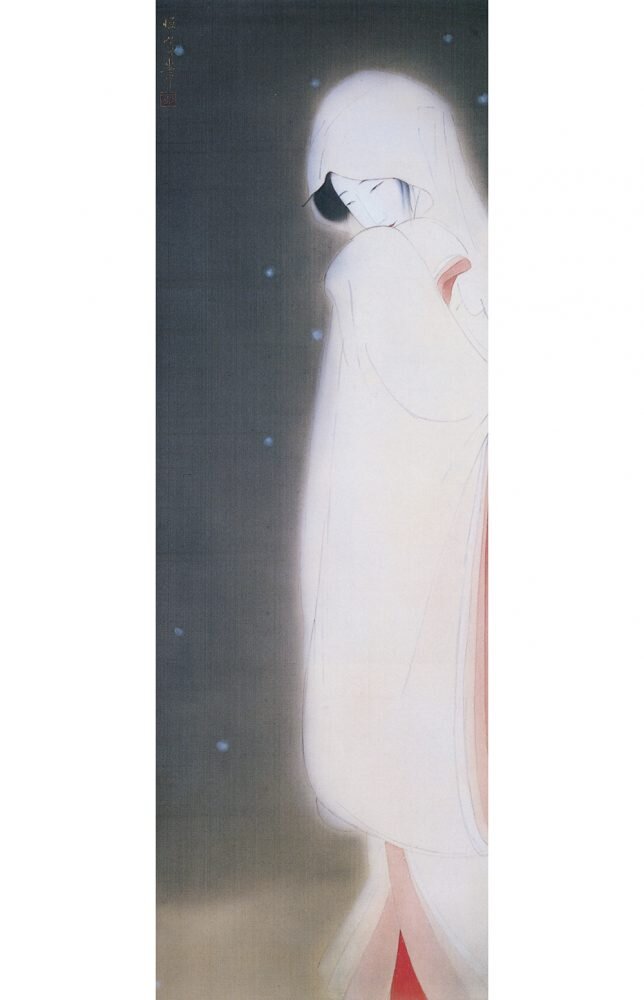
And yet a world of bijinga without Tsunetomi would be a dull one. The names anyone thinks of are Uemura Shoen, Kaburaki Kiyokata and Ito Shinsui; but the deep interest of the genre, and its air of mystery, would not exist, whatever anyone says, without the destructive activity of the Osaka painters — Tsunetomi, Kainosho Tadaoto, Shima Seien.
Painters from Tokyo, from Kyushu and from other regions add their flowers, of course; but a life given wholly to the painting of the figure is a life turned towards the nearest part of the great nature that moves us — that is, towards an interest in the human being; and there the life of the painter and the eye of the viewer meet, and often, across time, call up sympathy and feeling in us.
Tsunetomi’s work cannot be said to have been brought fully to light. Buried works that deserve the name of masterpiece will surely go on appearing. This stubborn craftsman of a painter, who came out of Kanazawa and settled, for some reason, in Osaka for the rest of his life, will go on surprising us like a kaleidoscope for a long time yet.

I am the second head of SHUKADO, and the third generation of the Tanaka family to deal in art. I grew up close to art and to old painting and calligraphy, but when I was young my interest was almost entirely in the cinema. Since I began working in art I have often thought what a waste those years were, spent without knowing how rich a world this is. Drawing on my earlier work as a systems engineer, and on the manual work before that (does film count?), I want SHUKADO to be an art company that is intelligent, expressive and warm — where the work and the welcome come from every member of staff, each putting their whole heart into it, rather than from one person alone.