Art Jakarta 2026
October 2 (Fri) – October 4 (Sun), 2026
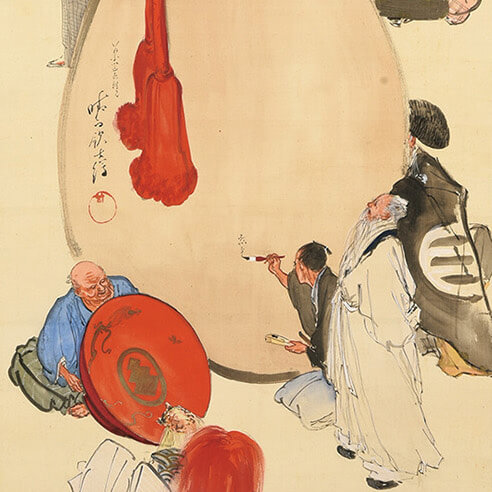
Did you see Ito Seiu’s Hyotan kara koma (A horse out of a gourd) in catalogue vol. 57? A horse comes trotting out of a great gourd, and around it are drawn any number of figures — if they are figures — who all look as though they mean something.
Ito Seiu, “A horse out of a gourd”
Unhappily the original box is missing, so we do not know the exact title. (Seiu’s works often come without their box; it may have been lost somewhere along the way, or there may never have been one.)
Seiu’s work can look unremarkable — scenes of Edo manners, things dashed off lightly — and yet motifs are worked into it, sometimes faintly, sometimes beyond mistaking. What they mean is remarkably hard to make out. To explain a piece to a customer therefore takes a good deal of patient work. Ito Seiu is, in short, one of the artists who make a catalogue editor weep.
This time we take up Seiu’s early life and the moments where you say: so that was it. (Next time we hope to offer a reading of the picture itself.)
Ito Seiu was born in 1882 in Asakusa (some say Kita-Senju). His father was the son of a hatamoto retainer, but the family had come down in the world and he made his living as a metal engraver.
Seiu drew well from early childhood. There is a story that when he was five, the abbot of Zojoji saw him draw a dragon and recite a sutra, and was so struck that he asked the father to make the boy a monk.
At eight he was apprenticed to Nozawa Teiu, a painter of the Rinpa line, and at twelve he went as a shop-boy to the ivory carver Naito Seiso. He went on learning to draw at the same time, copying the illustrations of Migita Toshihide from the Tokyo Asahi Shimbun, which the Naito household took. Toshihide (1863–1925) was a pupil of Tsukioka Yoshitoshi, an ukiyo-e artist known for bijinga, war prints and actor prints.
Seiu then set his heart on painting. At about twenty-three he gave up his service, took himself off to the theatres and began painting signboards. A love of the stage since childhood served him well: by about twenty-five he had joined a newspaper, was illustrating novels and kodan storytelling, and was running a column of theatre criticism that made his name. He came to be recognised as a painter too.
From this time into his thirties he called himself Ito Seiu written with different characters — taking one character each from the names of his two early masters, Nozawa Teiu and Naito Seiso.
When he first made his living by illustration he was more or less self-taught, and there is a story that the newspaper nearly dismissed him for drawing badly. In those years there was more demand for his writing — on the theory of the theatre and so on — than for his pictures, which tells you what his eye and his knowledge of the stage must have been. He worked on period research and on the study of manners, founded a theatre company, and is said to have played the female roles in his own scripts. After the Great Kanto Earthquake he joined Sawada Shojiro’s Shinkokugeki and made his mark in the theatre world as well.
Say Seiu, of course, and everyone thinks of seme-e, his pictures of bondage: young beauties, the black hair of the shimada coiffure pitifully undone, put to every kind of torment — sadistic and erotic at once. He began them in his middle thirties, and they made his name at a stroke. To this day he is spoken of as the great master of seme and the first authority on its study.
What set Seiu on seme goes back to childhood, which argues a thoroughgoing disposition: the torture scene of Takeo in Yoshida Goten, Maneku Furisode, which his mother took him to see at the Kotobukiza in Honjo when he was ten; and the snow-torture of Princess Chujo in Hibariyama Koseki no Matsu, which his mother told him about when he was around seven.
The first model for the seme-e was Sasaki Kaneyo (later Nagai Kaneyo), whom Seiu met when he was thirty-four. She had modelled for Fujishima Takeji, the great master of modern Western-style painting; she was called Okane, and at twelve she was already an idol among painters and art students, a beauty from Akita. Seiu lost his head over her wilfulness, took her as model and as mistress, and in that time drew a great many seme-e and took a great many photographs “for reference”.
Three years after they met, Kaneyo left him. He said later: “The face of the woman I am painting now is what she left me.” She mattered greatly to his work, and those were years of very dense production.
Sadly, the studies and drawings he made then were burned in the war. Not one survives.
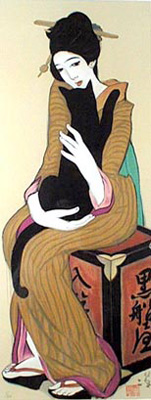
As for what became of Kaneyo: in Seiu’s own words, “this woman was later taken from my hands by Takehisa Yumeji”. She became Yumeji’s lover and model, was given by him the name Oyo, and sat for Kurofuneya, his best-known work — it has been on a postage stamp — and for a whole series of Yumeji beauties. She was his muse.
A further aside: six years after parting from Yumeji, Kaneyo, then twenty-eight, met and married a doctor three years her senior. She is said to have had a quiet married life until her death at seventy-six.
Quite as dramatic a life as Seiu’s own.
Seiu, meanwhile, divorced his wife Takeo after Kaneyo left him. He married his second wife, Sahara Kise, and from then on nearly all the seme-e are of her.
The famous photograph of a woman in the last month of pregnancy hung upside down — a reconstruction of Tsukioka Yoshitoshi’s “The lonely house on Adachi moor in Oshu” — was taken with Kise as the model. In these years he went out into the country for snow-torture sessions and photographic shoots, and his work with seme became steadily more experimental.
The Great Kanto Earthquake of 1923 turned his life over, and the following year he and Kise divorced. It must have been the loss of the familiar streets in that unheard-of disaster that set him off: from about this time Seiu threw himself into the study of the Edo manners that were vanishing so fast, and of the theatre and the sideshows. He published the material he had recorded so carefully, together with his reconstruction drawings, as Iroha-biki: Edo to Tokyo Fuzoku Yashi, and it remains a valuable source today.
He took a third wife, Toshiko. In the field of seme he now went well beyond his own private taste; coming to know the researcher of sexual manners Takahashi Tetsu carried him further still, into thoroughgoing study and the collecting of material. It was in these years that he brought out, one after another, the works still spoken of as classics — Seme no Kenkyu, which was banned, and the erotic Rongo Tsukai among them.
Toshiko died in 1935 after ten years of marriage. When the Pacific War came, Seiu lost everything he owned in the Tokyo air raids, as we have said: every photograph he had taken, every drawing he had put by, every rare book he had collected. It seems to have told on him: after the war the publishing, which had been so vigorous, stopped. But he went on with his magazine serials, his essays and his autobiography, and went on putting out the study and the making of seme all his life.
He died in 1961, watched over by his eldest daughter Kikuko, at the age of seventy-eight. Since then a great many artists have gone on keeping his figure alive in novels, in films and in work of every other kind, taking that rare life for their subject.
Next time, starting from A horse out of a gourd, we shall show you — at the risk of some embarrassment — how the catalogue staff go about studying a work, puzzled and enjoying themselves at once. Look forward to it, if you dare.
Adapted from our email magazine, Nihon Bijutsu So Datta no ka Tsushin, vol. 384.