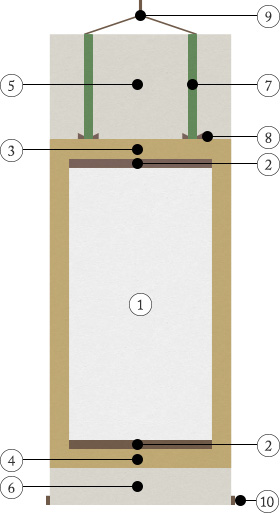
The work itself, on which the painting or calligraphy is done. Usually paper or silk (shihon or kenpon).
② Ichimonji
The narrow bands of cloth above and below the honshi. Usually the same cloth as the futai, and usually of the finest quality on the scroll.
③④ Chumawashi
The cloth surrounding the honshi and the ichimonji, generally of a lesser quality than the ichimonji. The part above the honshi is called naka-no-ue, the part below naka-no-shita, and the strips at either side hashira, the pillars.
⑤⑥ Joge
The cloth at the top and bottom of the mounting. Often the same cloth as the futai, and usually of good quality.
⑦ Futai
The two long, narrow strips hanging from the upper section (ten), placed at roughly one-third intervals across it. They are not used in literati mounting. Usually the same cloth as the ichimonji. Strips pasted flat rather than hanging free are an abbreviated form, called oshi-futai.
⑧ Tsuyu
The cotton threads attached at the lower corners of the futai. White ones are called tsuyu, dew; coloured ones hana, flowers.
⑨ Himo
The cords: the kake-o, from which the scroll hangs, and the maki-o, wound round the rolled scroll to hold it closed when it is put away.
⑩ Jikusaki
Also called jikubana. The knobs at either end of the roller around which the scroll is wound; you take hold of them to roll it up. Made of ivory, bamboo, lacquer or ceramic. See also: handling a hanging scroll.
■ Techniques and materials
Iwa-enogu (mineral pigments)
The pigments used in nihonga and in Chinese painting and calligraphy, made from natural minerals. They do not dissolve in water, so animal glue (nikawa) is used as the binder.
Urauchi (backing)
Paper or cloth pasted to the back of the honshi of a scroll, or to the back of a canvas, to protect and strengthen it.
Urazaishiki (colouring from behind)
A nihonga technique: colour applied to the back of the silk or paper, giving an effect quite different from colour applied to the front.
Kao (cipher signature)
A signature worked into a design. Many kinds developed as a guard against forgery. Those of warlords and of the heads of tea schools are often seen.
Gasan (inscription)
A poem, a waka or a haiku written in the empty space of a painting; also simply san. It may be written by the painter or by someone else, at the time the work was made or later by an owner.
Kantei (authentication)
Judging whether a work is genuine, after the artist’s death. Usually done by a relative or a pupil, though today an authentication committee is often used instead; for Western-style painting a leading dealer may act as the point of contact. Where a work is judged genuine, a certificate or a seal is issued, or an inscription is written on the box. See also: designated authentication.
Kanteisho (certificate of authenticity)
A certificate of genuineness issued by the designated authenticator. For well-known artists of the modern period who have died, only a certificate from the authenticator or body designated for that artist is valid in a sale. See also: list of designated authenticators.
Kiwamegaki, origami
A certificate of genuineness written by hand by the authenticator. (Hence origami-tsuki has come to mean “guaranteed”.) Certificates in origami form are often found in the boxes of paintings, calligraphy and tea utensils from before the Edo period.
Gouache
An opaque watercolour paint, bound with water-soluble gum arabic.
Kenpon (on silk)
Painting or calligraphy done on silk.
Go (canvas number)
Originally a French unit of canvas size. In the Japanese art world the size of a framed work is usually given in go. The number is set by the longer side, whichever way the picture is oriented. Table of standard canvas sizes
Kohitsugire (fragments of old calligraphy)
Fragments of old calligraphy: pieces cut from anthologies and other works that were once scrolls or books. They were mounted as hanging scrolls or gathered into tekagami albums, and much prized.
Gofun (shell white)
The white pigment used in Japan, made by firing shells and grinding them to a powder; used with animal glue as the binder.
Thumbhole
The word comes from the small sketching box with a hole for the thumb, carried in one hand; by extension it now means a work of a size between 1 go and 2 go. Table of standard canvas sizes
Sanpukutsui (triptych)
Three hanging scrolls painted to be seen as a set. (Scrolls are counted ippuku, nifuku, and so on.) A common arrangement is a landscape at either side and a figure in the middle. Pairs, sets of four and sets of twelve are also found.
Shihon (on paper)
Painting or calligraphy done on paper.
Tato
Short for tatoshi: heavy folding wrapping paper, Japanese paper treated with persimmon tannin and the like. A paper case for a frame or a paulownia box.
Tekagami (album of calligraphy)
An album made up of notable fragments of old calligraphy, or copies of them. They were made originally as reference for authentication, and later for collectors to enjoy. They were once an important part of the trousseau of a daughter of a samurai or court family.
Nikawa (animal glue)
The binder used with mineral pigments, made by boiling down the hides, bones and intestines of animals to extract the gelatine.
Tomo-shīru (the artist’s own seal)
A certificate attached to a new work by the artist to attest to it, usually pasted to the back of the frame. One added by an authenticator instead is called simply a shīru. It normally gives the title and the subject.
Tomobako (the artist’s own box)
A box inscribed by the artist. It serves as evidence that the work is genuine.
Hakogaki (box inscription)
The inscription on the lid or the side of the box in which a work is kept. It normally gives the artist’s name (signature and seal) and the subject. Where it is not by the artist, it usually gives the name of the authenticator along with the artist’s name. For nihonga and tea utensils it weighs heavily in judging authenticity and in valuation.
Matière
The surface and texture of a painting.
Rakkan (signature and seal)
The artist’s signing and sealing of a finished work; short for rakusei kanshi. The art name is written in the empty space and a seal (or a kao) applied. The year, the season and the artist’s age are often added before the art name.
Rokkyoku issō (a pair of six-panel screens)
A pair of screens, each folding into six panels, that form a set. Screens are counted isseki, niseki; a left-and-right set is called issō. A screen that is not part of a set is described as, for example, yonkyoku isseki, a single four-panel screen.